
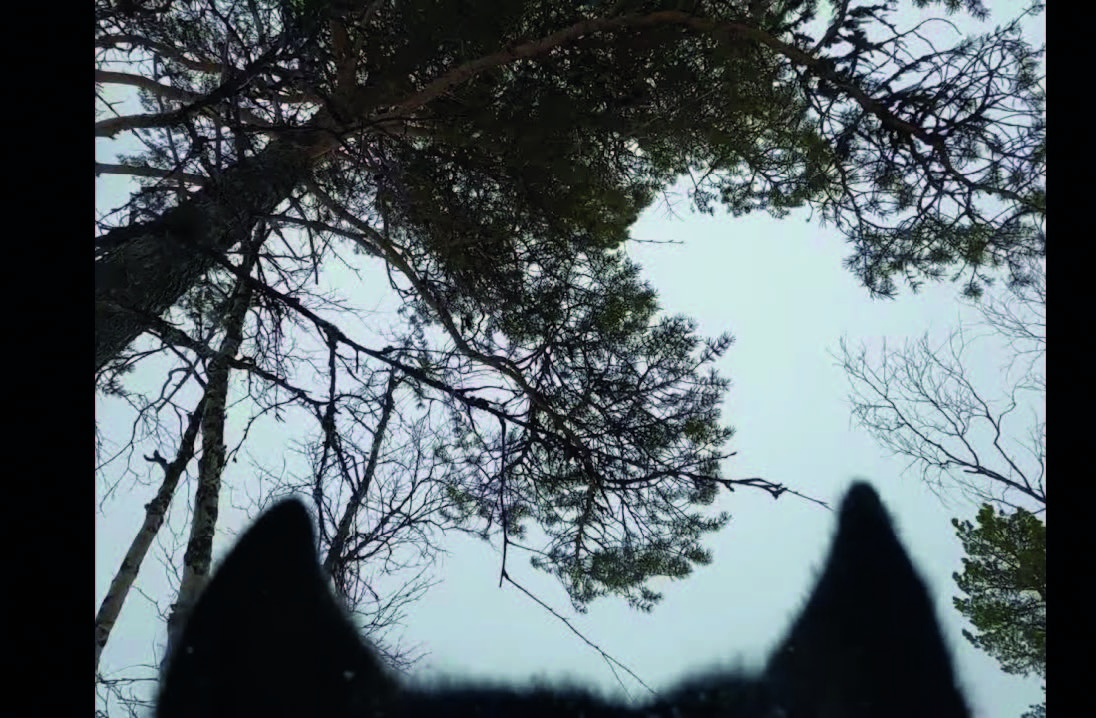
Mirja Hiltunen & the dog
Rewilding is based on a nature conservation principle that highlights how fragmented and endangered ecosystems do not provide sufficient habitats for endangered species. My aim in my video Rewilding Mind 2.1 is to expand the theme, landscape, to cover both non-human and human experience as part of nature and critical explore also humanity and its normalicy as with my co-artist, the Lapponian Herder, Jarppi. In the video the dog´s landscape plays the main role.
In the video, the human steps aside, and the dog’s aestheticalperspective on the landscape takes on the main role. The video contains references to neurophysiology, but I also take up a post-humanistic approach, emphasizing the need for rewilding from the point of view of the human species.
Rewilding means returning to a wilder or natural state; it is the process of undoing domestication (Olsen, 2021). From this point of view, working with a dog in a rewilding context raises several ethical questions, because dogs have been domesticated from what was once a common ancestor with wolves. My concern during the process was anyways connected more to working with “the other,” as I was facing the ethical question “Can the subaltern speak? “(Spivak 1988). “Subaltern” is a concept which is typically used to refer to another human being following the postcolonial theorist, Gayatri Spivak. The concept of the “Third Space” (Bhabha, 1994, pp. 54-56), as an ambivalent space between two subjects where cultural meanings and symbols can be interpreted in new ways, also settles into this interplay between the two, in my case the human and the dog, and offers a space for encounters and learning. Sara Ahmed (2000) also refers to “strange encounters” that are open to new interpretations and thus ethically sustainable.
In cooperation with the dog, I strive to convey equality and interaction between human and non-human nature. The video can also be seen neo-materialistically as my attempt to break away from effects on human affectivity, my own cultural and individual structures to experience the landscape and try a different kind of being.
While concentrating on landscape, I wonder whose way of seeing and experiencing is the right one, human’s and only the one’s, who may be considered average? From which and whose point of view is good defined. For example, what is health when the boundaries of the normal are narrowed continuously? Like many animals, humans can be domesticated. And we live in a culture where domestication is the norm. I ask myself, as an aging grandmother of four wonderful grandchildren, two with special needs, and as a daughter of an old father suffering from/ or living with Parkinson’s disease, should our general mindset about disability and illnessor f.ex. aging, go wild? My lovely colleague, associate professor Wenche Sørmo, who took part to Lila Spring school gave me even more to think about, when giving me feedback in one of our seminars. Here I like to share her thoughts:
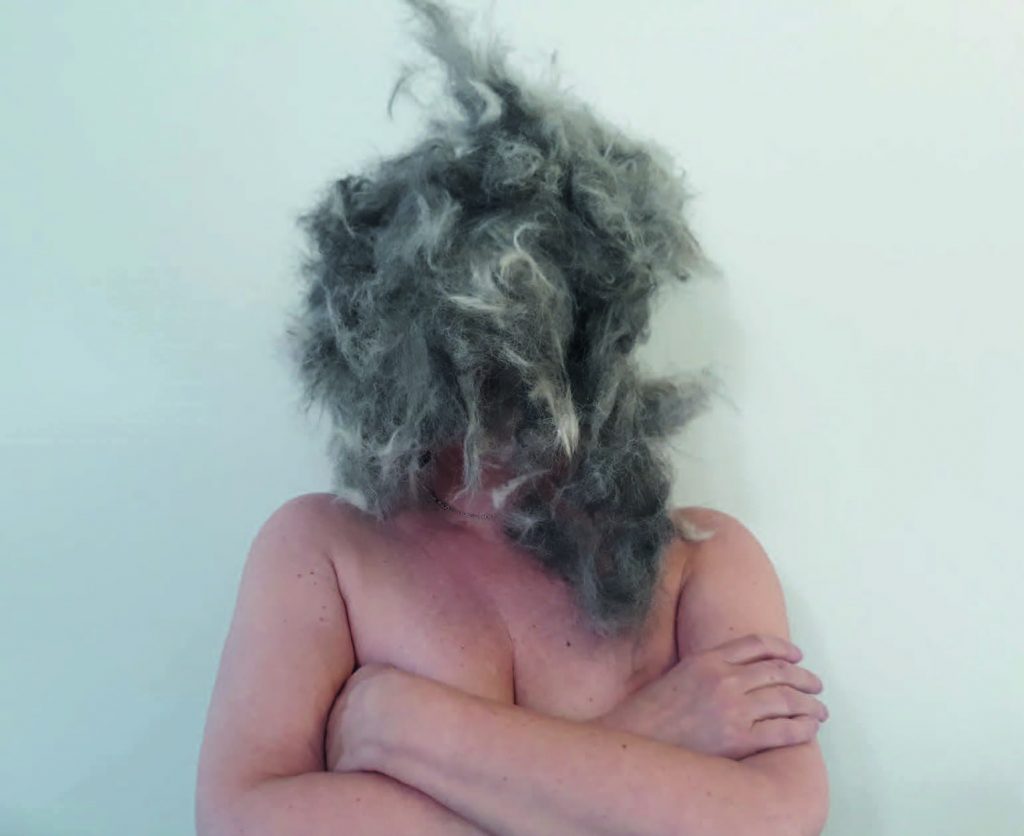
This installation and the text made me reflect on the absurdity of us humans making all sorts of (mostly) bad decisions on behalf of all other organisms on our planet. I loved the movie that you and the Lappish co-artist dog Jarppi had made. It showed me the joy of being on the run and feeling free, but at the same time, being on patrol and checking every bush and tree along the way. It was obvious to me that he found the forest areas close to the river very interesting: sniffling the twigs and the branches, making his own mark on the vegetation, listening to the sounds, and looking for signs of other dwellers. […] On the snow-covered areas along the river, the speed of the dog was high. He loved to run but was also eager to check out new, more vegetated areas along the way where he used his sense organs to send affective signals into his brain for further processing but still kept in contact with, and maybe was somehow inhibited by, the presence of humans. Most of the planet’s nature is threatened by humanity’s increasing desire to exploit it for the growing population: the oceans are polluted and filled with plastic; smog is making people and other organisms sick; forests, the lungs of the earth, are being cut down; and the shrinking natural habitat of plants and animals is sending co-dwellers into extinction. And it all comes down to chemistry—the chemistry that we find inside our nerve system. In relation to the picture in Mirja’s installation, I interpreted the dog’s hair as a representation of the neurons of a human brain. Our brain, with its chemistry and connections between neurons, is what causes trouble, making us humans think that only our way of perceiving and making decisions about our planet is what is important. […] I think that our mindset really should “go wild,” as Mirja would say, to enable us to fully understand the “nature of the nature” that we all are so dependent on.“
Thank you Wenche for your profound feedback and interpretation of my work. Sharing has been the most rewarding, even rewilding, aspect of the LiLa Spring School, as we learned from each other and enjoyed discovering new perspectives on the landscape and on ourselves. Living in the Landscape refers to me to the idea that humans are no longer considered the only agentic subjects but agency and subjectivity spread more widely: humans are embedded in an ecological community without being exceptional (see Malone, 2015), but being as diverse as the ecological community, with all its variations.
References
Ahmed, S. (2000.) Strange encounters: Embodied others in post-coloniality. Routledge.
Bhabha, H. K. (1994.) The Location of Culture. Routledge.
Malone, K. (2015). Posthumanist approaches to theorizing children’s human-nature relations. In K. Nairn (Ed.), Space, place and environment (pp. 1–22). https://doi.org/10.1007/978-981-4585-90-3
Olsen, M. (2012) Unlearn, Rewild. New Society Publishing,
Spivak, G. C. (1988). ”Can the Subaltern Speak?”. In Lawrence Grossberg & Cary Nelson (Eds.). Marxism and the Interpretation of Culture, (271-313). University of Illinois Press.