Collective video artwork assignment was part of the New Genre Arctic Art Education -course, which was a hybrid collaborative course connecting participants from Umeå University (Sweden), University of Lapland (Finland), Nord University (Norway) and Greenland University (Denmark). The making of collaborative artwork aimed to explore the possibilities of digital tools to engage the participants in a shared art process over distances.
Text: Ante Jalvela and Emilia Tuononen, University of Lapland, Finland
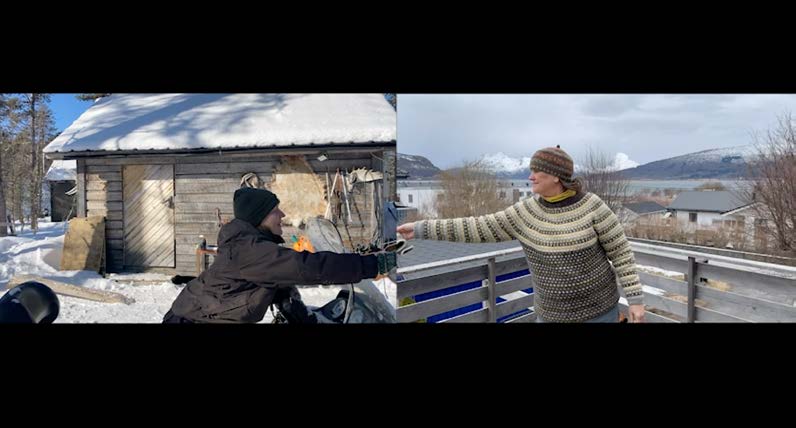
Cover photo: Screenshot from the video artwork Ante Jalvela, 2024.
Summary
The video collage was a warm-up task aimed at promoting dialogue among participants in the online phase of the AAE course for university students. The goal for the participants was to present their perspectives on the Arctic using Arctic objects of their choice and the stories related to them. At the same time, the aim was to concretely illustrate the cyclical nature of Arctic ecocultures (particularly Sámi culture in this case) through contemporary art-based action.
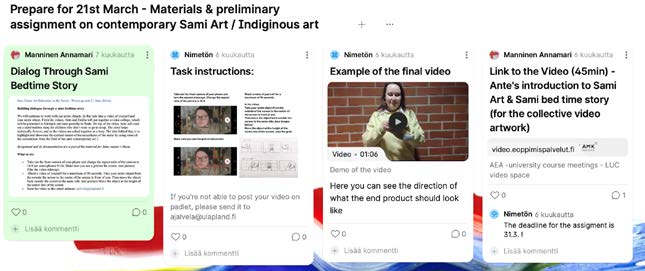
At the beginning of the online phase of the AAE course, each participant was tasked with selecting an object, large or small, that represented their experience of the Arctic. This Arctic object was presented to everyone and later used in this video collage assignment. We wanted to bring the participants from different countries, universities, and disciplines together in a way that aligned with the core values and goals of the AAE project, enabled by the online platform. The idea of a conceptually interactive video collage emerged, and we began preparing the task. We wrote brief instructions for all participants on how to make a short video of themselves with their Arctic object. Afterwards, we would collect all the submitted videos and edit them into a cohesive video, which could technically loop forever. In the video, the participants appear to be passing their Arctic objects to another participant, from one side to the other. A story is heard over the video, which repeats along with the visuals.
At the heart of the video collage was a Sámi bedtime story Ante originally heard from his cousin. The story is usually told to children who don’t want to go to sleep and keep asking for a new story. It goes like this:
I was walking on top of the Njállavárri. I walked for some time, and after a while, I came across a black house. Once I reached the house, a person came outside. ‘’There’s the late Biret!’’ the person yelled.
I opened the door and saw the late Biret lying on the floor. I started to resuscitate her, and she woke up. After that, she stood up and showed me a door, which she entered an gestured for me to follow her. After I entered through the door, I realized…
And the story starts again. After a few repetitions, the child will likely ask to stop. Njállavárri is a familiar fell near Ante’s family’s home place in Njuorggán, but the story does not have a fixed setting as it is always told from the storyteller’s perspective.
Many course participants were confused by the warm-up task, and not everyone was entirely sure about the idea of the story and collage. However, as a technical digital implementation of participants recording and sending their videos, the task was successful. Creating community art to build a sense of belonging is a challenge in an online environment. All participants have different levels of skills and tools to engage in meaningful dialogue. One possible solution could be a platform where each participant can contribute and modify the shared work while interacting during the process.