
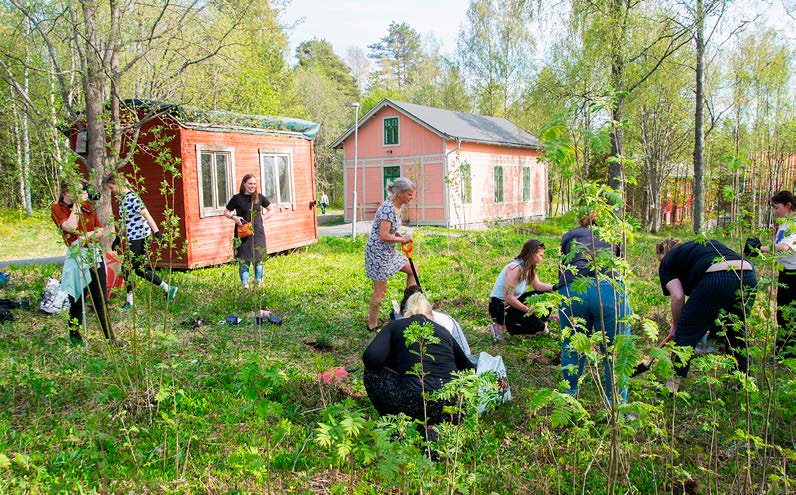
Living in the Landscape workshop team: Annika Kokko, Saara Lappeteläinen, and Karti Pyy. University of Lapland. Participants: LiLa community 2023. Collaboration: ASAD network,Västerbotten museum. Umeå, Sweden, May 2023.
Text: Saara Lappeteläinen, University of Lapland, Finland
Cover photo: Annika Kokko
Summary
In this workshop, we used planting as an art-based tool to find a connection to a local sociocultural landscape and each other. As art educators, we questioned our contribution to our community and a better future. In this workshop, I wanted to approach this question from an ecosocial point of view, aiming to bring local knowledge and action together with global thinking – believing, of course, in art-based practice as a tool for reaching our goal.
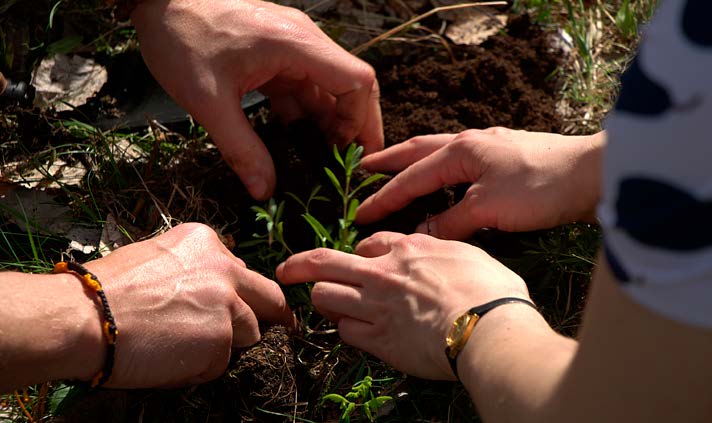
As part of the Living in the Landscape (LiLa) summer school 2023, I organized this workshop with two fellow students from the University of Lapland. The workshop was working partly as art education and partly as an art-based method for landscape research, which is at the core of the LiLa summer school. The workshop’s goal was to evoke thinking and knowledge about ecosystems and the intertwined connections that we are a part of along with everything else, and feelings of community, hope, and the capability to make a difference.
This workshop was theoretically based on ‘ecosocial civilization’, which is a concept that aims to find a more sustainable order of living through questioning the Western concept of a good life, finding togetherness, and adopting a larger circle of care. Also important for this theory is to look at the hierarchy upon which we have built our society and change it so that we start honouring the limitations ecology sets for our actions (Salonen & Bardy, 2015). In the workshop, we approached this with performative, communal, and environmental art-based practice. For the workshop, we had acquired plans that benefit the local ecosystems and agreed with our contact person from Västerbotten Museum that we could do the planting in the area connected to their outdoor museum.
To reach our aim to think differently about our place in the ecosystems and the possibilities in our actions, we wanted to do the planting a little differently from what we are used to. We often plant to make our surroundings look pretty, which can often be harmful to the ecosystem. In the workshop, we wanted to change the approach and reasons behind the planting. In this workshop, we planted for the ecosystem where people cannot always see the plants. Another important angle to the workshop was strengthening the sense of community and sharing knowledge with each other.
During the planting, the majority of participants did not want to use the cloves we provided because they wanted to feel the soil with their hands. The bodily knowing with the use of all the senses, care, and nurturing were very present at the workshop. We also had a lot of feedback from participants who felt empowered, a joy of giving back, enjoyment of interacting with the ground and nature, and a sense of togetherness and teamwork. People also said that planting like this was a new experience, and it felt strange but good.
Because of practical reasons and restrictions, the surroundings and the vegetation at the workshop location were unknown to us organizers. Even with local contacts, we must consider whether future workshops should only be held in familiar locations to prevent unintentional harm to the ecosystem. Having the opportunity to give back to a place we were visiting was seen as very valuable. This is definitely something to apply in future educational situations and within the daily landscapes of communities.
Reference
Salonen, A. & Bardy, M. (2015). Ekososiaalinen sivistys herättää luottamusta tulevaisuuteen. Aikuiskasvatus, 35 (1). [Ecosocial civilization evokes trust towards the future. Adult Education, 35 (1).] https://doi.org/10.33336/aik.94118