The workshop was in Norway, Karasjok, where we worked together with the Sámi Contemporary Art Centre (SDG) and a local school in early April 2024. The University of Lapland workshop team was the master students Silja Peltola, Riitta Sirkiä, and Emilia Tuononen, supervised by lecturer of art education Annamari Manninen, professors Timo Jokela and Mirja Hiltunen, in collaboration with Hanna-Leena Metsävainio from cross-art collective Piste, Rovaniemi. The main documentation and editing of the video was done by art education master student Ante Jalvela.
Text: Silja Peltola and Emilia Tuononen University of Lapland, Finland
Cover photo: Emilia Tuononen (left) and TImo Jokela (right) 2024.
Summary
The theme of the workshop was river which flows through the Karasjok village. The topic was connected to northern nature and relevant to the participants, eighth-grade pupils, and to their everyday lives. In the workshop, we focused on what kind of words, images, colours, and movements the river brought to mind. The subject was started with a gallery visit, then explored through painting, which expanded into a performance on the frozen Karasjok River. Afterwards, the video of the performance was presented to the participants at the opening of a pop-up exhibition.
The aim was to create an opportunity for local eighth graders and our project group to work together on Arctic themes using the techniques of expressionist contemporary art. We wanted to forge a connection between the local people, our project group, nature, and art. The workshop aimed to use methods of Arctic contemporary art in education to strengthen and preserve northern knowledge, respect eco-cultural continuity, and improve cultural resilience and sustainability. We sought to place the students’ connection to their local nature and community at the heart of the project.
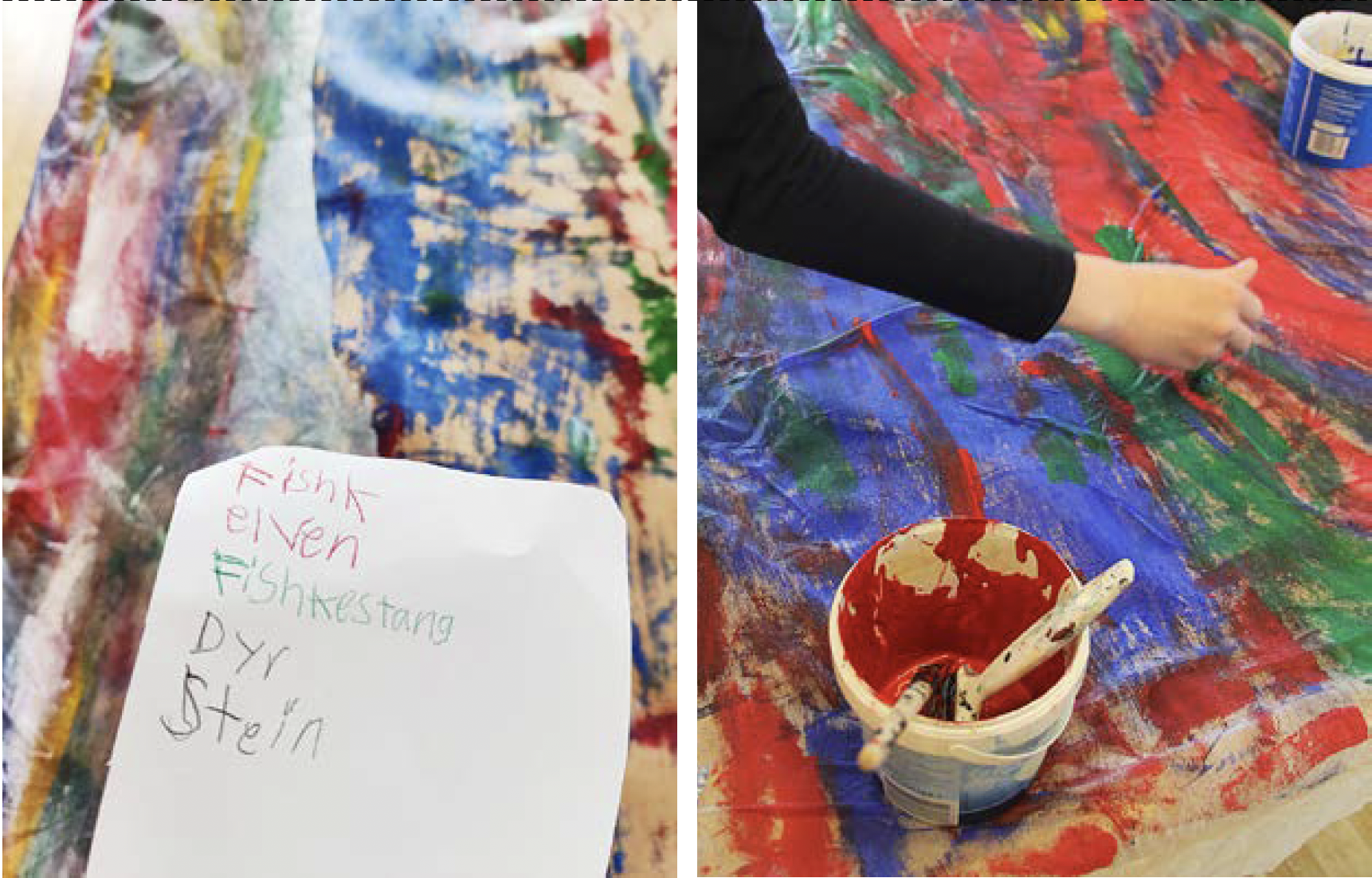
Before the workshop, a guide at the Sámi Contemporary Art Centre introduced the pupils to the exhibition of the artist Per Adde. This artist depicts northern nature and animals in an expressionist and abstract way in his paintings. After the exhibition visit, the pupils were instructed to write down on paper some words that they associated with the Karasjok River. The river as a topic was chosen beforehand by the class and suggested by their teacher. The pupils were then encouraged to use these words as inspiration for their paintings, and they were urged to incorporate a lot of movement, expression, and colour – rhythms of the nature of the river.
The paintings were created collaboratively on long strips of gauze fabric with a mixture of acrylic and gouache paint. The pupils were set around the tables, and every three minutes, they were supposed to change places (see Figure 1), allowing them to create the artwork together. By the end of the workshop, the pieces of fabric were filled with vibrant paintings.
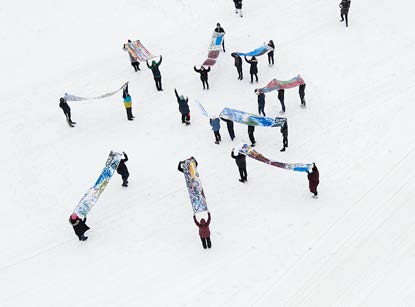
The workshop continued with a performance on the ice of the Karasjok River. Participation in the performance was voluntary, but it was delightful to see many pupils take part. The performance included choreography wher pupils held and moved the fabric strips while a drone filmed the event. In the finale, the fabrics were tied to a snowmobile, which drove around the ice, displaying the fluttering paintings. The performance was filmed. The documenting material was quickly edited, and the performance video was shown the next evening in the pop-up exhibition we held after all the workshops at the Sámi Contemporary Art Centre.
The pupils were motivated to participate, and they seemed enthusiastic about painting on large fabrics. The quick tempo of the painting workshop seemed to suit the energetic eighth graders. Unfortunately, the weather was grey and rainy during the performance, and it didn’t look quite as we had envisioned. Based on the participants’ feedback, we realized that the contemporary art-related idea of the performance remained somewhat unclear to the pupils. Nevertheless, the pupils were very brave to take part in the performance, especially considering the bad weather. The pupils were also excited to see the finished video of the performance, which shows that it is important for them to see the result of their work. The filming with a drone from above also got them interested in seeing the footage. Perhaps one of the accomplishments of the workshop was to show the pupils that art doesn’t always have to be serious and that there is room for play and spontaneity.