
Text: Karin Stoll
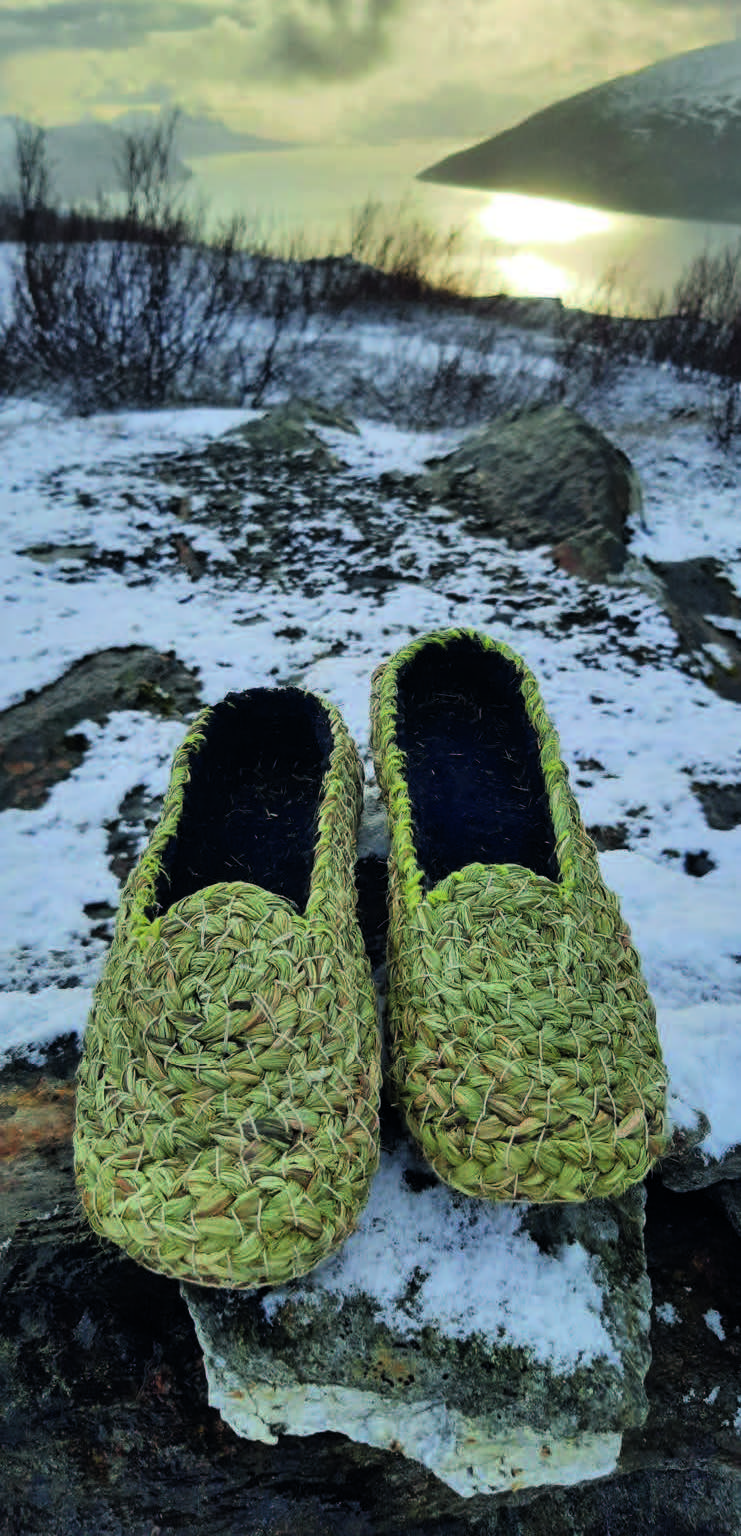
Cover photo: Bavarian Grass Shoes in the Landscape of Helgeland, Northern Norway. Photo: Karin Stoll.
The project “Dyeing in a Landscape” is about communication and immersion in the world of participants at a distance. Any joint activity contributes to bringing people together in a group. If people already know each other, it strengthens the connection between them. The online format limits the possibilities, but nevertheless allows you to get to know the world of the interlocutor deeper.
As a four-year-old girl living in Bavaria, Southern Germany, I often wore my grandmother`s slippers made of grass. I remember that she used to smile and say: “My little girl, why do you want to wear these shoes? They are shoes from the wartime (World War II).” I did not understand why she said that back then, but I loved the shoes and the smell that reminded me of summer. Later I realized that this were shoes people could make themselves using free materials from nature.
This essay lifts the crafting tradition of grass shoe making and its significance for forging close ties between nature, culture and one’s own identity. It seeks to overcome divisions between culture and nature, human and non-human. In this way rooted in a post humanistic and new materialistic way of thinking (Barad, 2003; Friedmann, 1994; Ingold, 1993) and shows how you can construct knowledge through making.
As a natural scientist rooted in the idea of environmental sustainability it is understood that my worldview is post humanistic – ecocentric and focuses on the relationship between all living organisms, with equal rights, and their physical environment. In a more cultural sense of sustainability the biological diversity of the landscapes represents natural materials that has inherent and traded knowledge.
Grass and shoes
In 1991 I saw the mummy of the iceman Ötzi in South Tyrol.
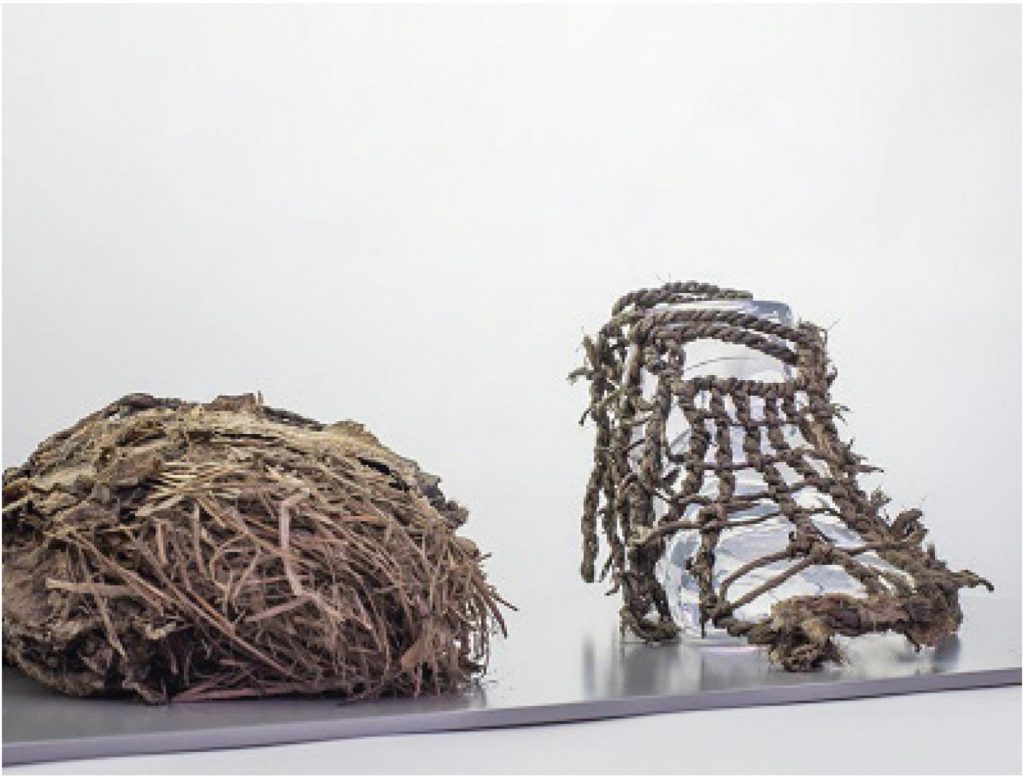
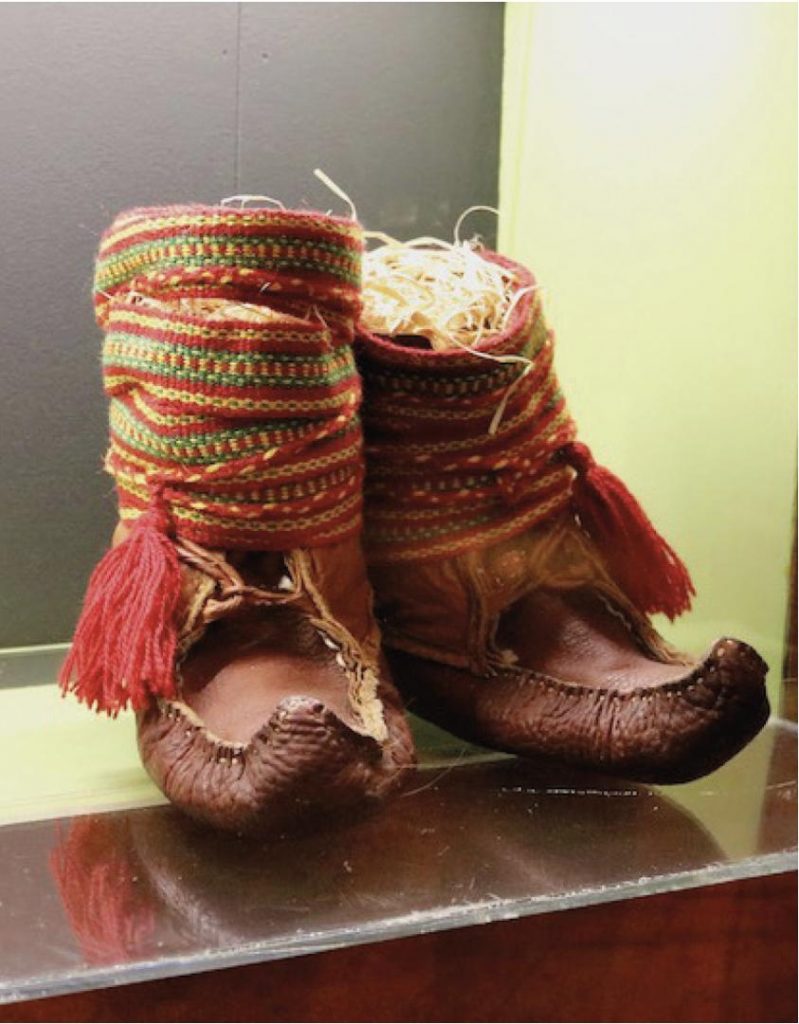
He is a mummified human who lived in the Neolithic about 5200 years ago. He had just been found in a glacier in the Alps when I as a paleontology student got the opportunity to see the remains, but also his clothes and equipment. His shoes consisted of a shell and sole of bear and deer skin, a skeleton of linden bark and dried grass and sedges (Figure 2) that were used as insulation (O’Sullivan et al., 2016), something we also know from traditional Sami shoes, called Skulls (Figure 3).
The meeting with Ötzi made a big impression on me, especially considering how much inherent knowledge lies behind clothes and the tools people made from materials they found in the landscape they lived in and were a part of. The tradition of using natural materials such as bark or grass to make daily life utensils and equipment is no longer visible in nowadays societies in Southern Germany, and much crafting knowledge related to this is gone. As a biologist I have gradually become more aware of the importance of taking care of materials and old traded knowledge as a part of the landscape around us. Seventeen years ago I moved from Southern Germany to Northern Norway, and I have noticed that there is a live crafting tradition that uses old traded knowledge, especially in the Sami, but also in the Norwegian culture. In my movement between cultures, I became aware of how valuable knowledge about using natural materials is. From a cultural sustainability perspective, cultural heritage is one of its main building blocks in developing cultural identity (Friedman,1994).
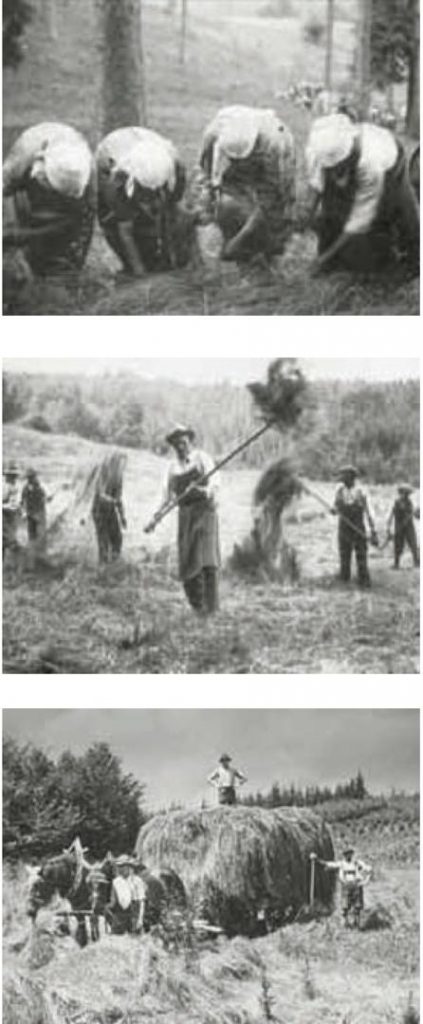
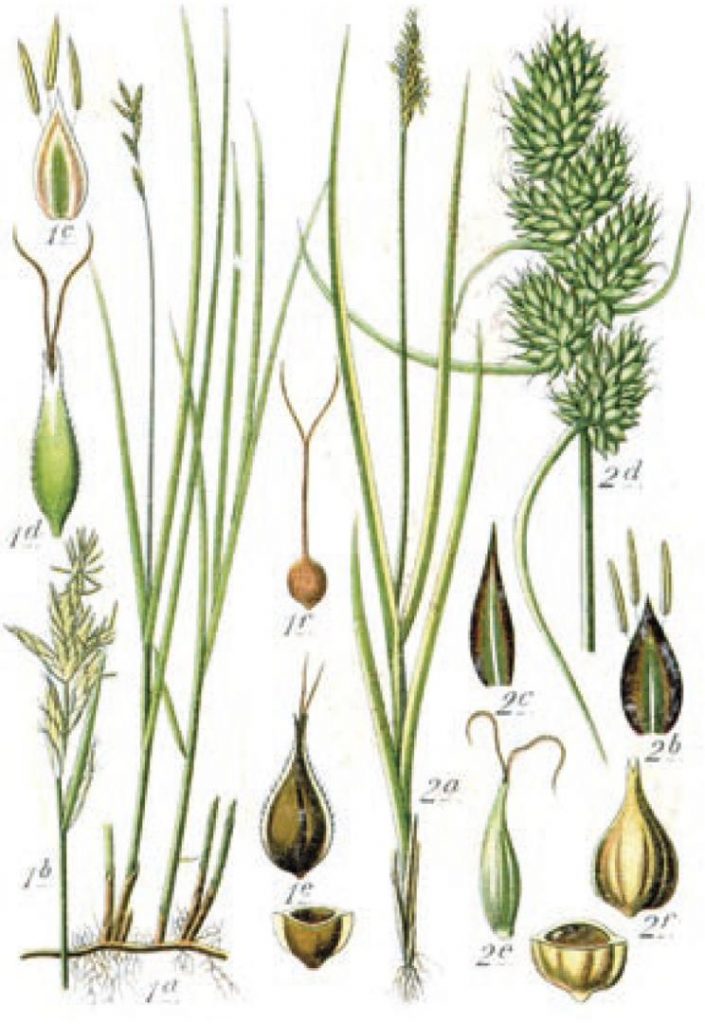
In 2017, I watched a documentary on Southern Germany TV about how a museum worked to revive the old tradition of harvesting sedges (Figure 4) and making Bavarian grass shoes (Bayerisches Fensehen, 2017), and got inspired to make my own grass shoes (Figure 1). I investigated whether the quaking sedge Carex brizoides which was traditionally used to make shoes and grows in the forest in South Germany is also found in my local environment in Northern Norway (Figure 5).
But this species is only found in the southern part of Norway (Koopman, 2011). Even where it occurs native, it tends to behave invasively in forests and form a thick layer on the forest floor and reduce species diversity. This is the reason why this species is blacklisted in Norway.
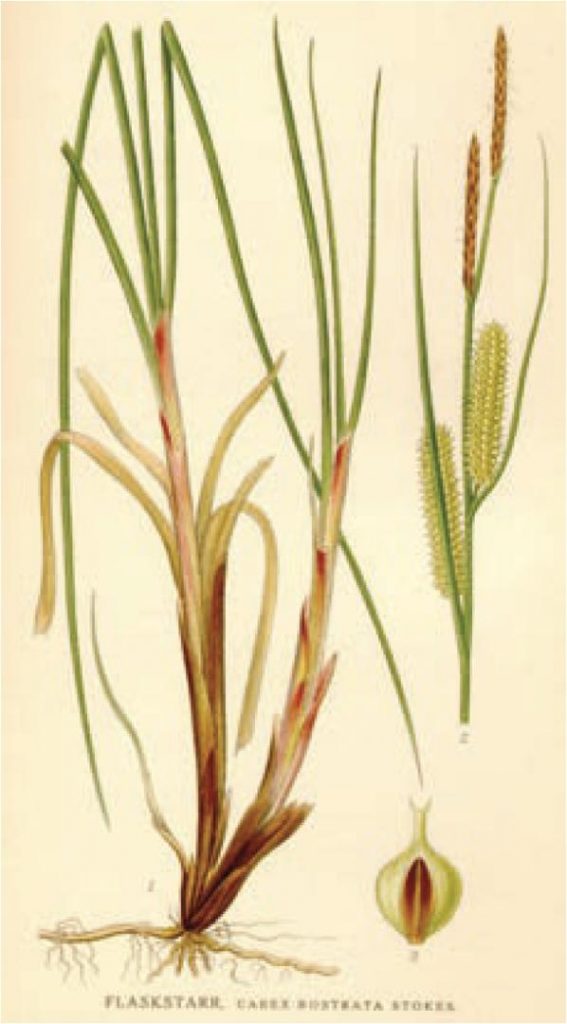
Carex brizoides does not exist in Northern Norway, and I had to find an alternative material for making the grass shoes. I heard that the Sami people use other sedges, such as Carex rostrata, the bottle sedge, for insulation in shoes (Figure 6). Therefore, I decided to find out if these arctic sedge species could be a suitable material for my gras shoe project.
I found huge quantities of Carex rostrata in a swamp not far from my home. I harvested it in early August before the leaves turned yellow and collected it in bundles to dry and stored it in an old sheet in the attic.
The Making Process
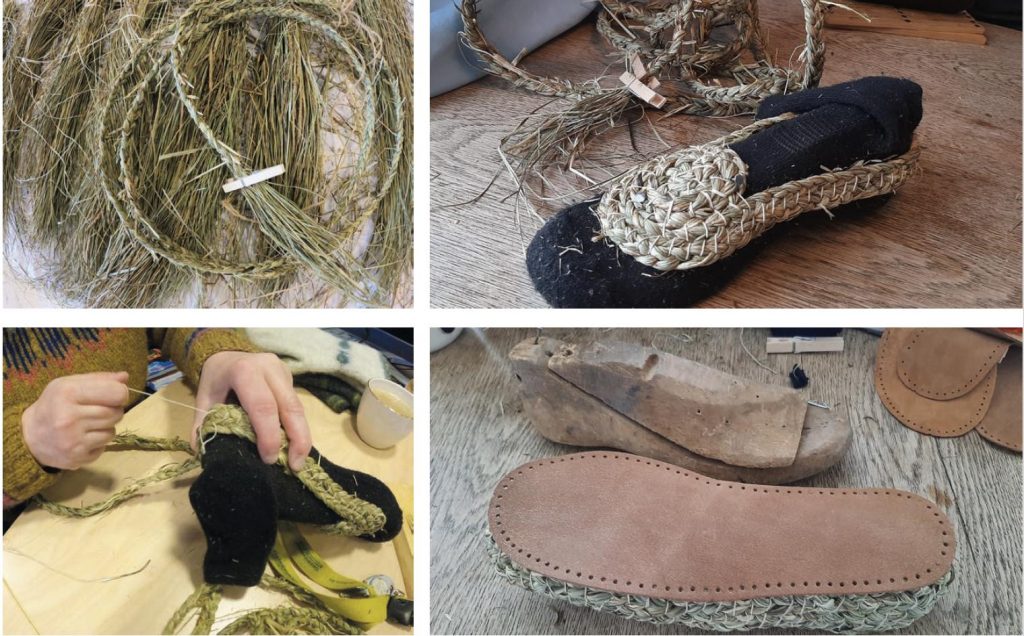
In addition to my childhood memories I interpreted and decoded pictures of the shoes and watched You tube videos of the making process (Bayerisches Fernesehen, 2017; Hola, u.d.). I started making a long braid, formed a circle of it and sew it together before I nailed it on the bridge of the shoe last. From there I continued to form the braid around the shoe last, sew it together and at the same time fasten it to the lining. I first tried to use a common wool needle, but experienced that a bent and pointed upholstery needle and an extra pointed craft needle worked better. My first choice of thread was lemon green made from strong linen, but it just broke even though I covered it with wax. I really liked the color and linen structure but instead I had to use a white, strong cotton and wax covered warp thread. I did not know how the material would behave but was surprised that the braids turned out to be both rather flexible and strong when I forced the needle through them. When I needed a break, I used
clothespins to fasten the ends of the grass braids (Figure 8).
For wrapping the grass braid to form the shoes you need a pair of shoe lats. Shoe lats were a common part of the households in Helgeland since “Svartlugger”, a homemade wintershoe, was a necessity to make for the members of the family. Svartlugger are made of a knitted woolen sock that has a felted piece of reused wool around the foot. I was lucky to get hand of a pair for my own shoemaking.
As lining in my grass shoes I also used an old pair of worn out woolen socks. Originally it was not so common to use lining, but I decided to use it, so that the shoes would get warmer and more comfortable to wear. I bought ready-made leather soles with holes to sew on the shoes.
Reflections
It is a lot of physically hard work to make grass shoes and I have gained a huge amount of respect for those who used to make shoes. It is also a continuing learning process, even after my shoes are done, which in itself is both satisfying and challenging. The whole process of making shoes from grass is a multisensory experience: the dried sedge has a light gray-green color, and at the same time it is smooth and strong and smells fresh, with a hint of lemon. When working with it, it is rustling and feeling like hay.
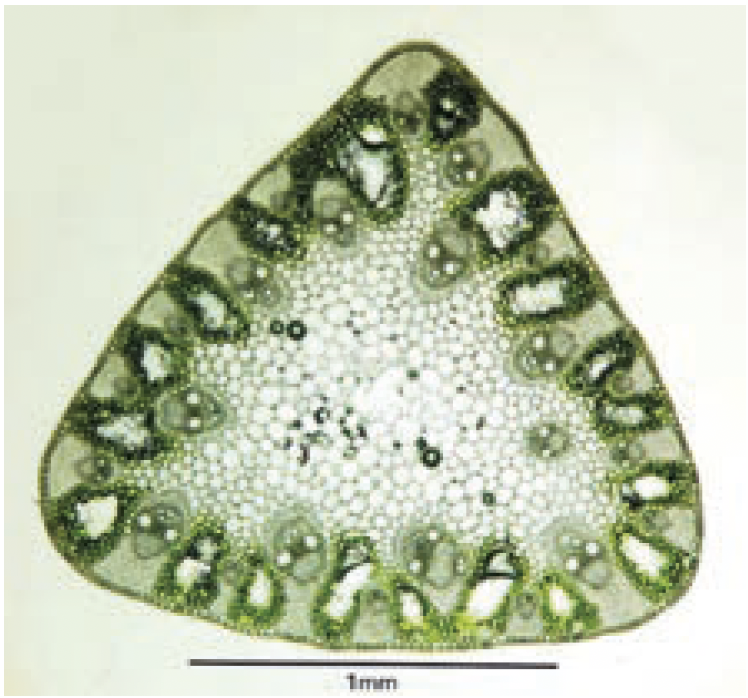
The combination of my natural science knowledge about anatomic and physiological properties of sedges and the practical experiences from working with this material/organism was useful for understanding why sedges are (still) used in shoe making. At a cellular level the air filled rooms in the stem tissue will both contribute in isolation and regulation of moist (Figure 7). Compared with real grass, the sedge stems have no nodes and are smooth and flexible. Therefore sedges will not break in the breading process while strong enough to make shoes out of it. Although I have never worked with the origin sedge species Carex brizoides, I can assume that it will be easier to make shoes out of it. The stems of the quaking sedge are described both softer and longer, properties which will make braiding much easier. According to Ingold (1993) my taskscape gained thickened experiences with and new knowledge about my co-dweller, the arctic sedge species Carex rostrata, as an organism and a material to make traditional Bavarian grass shoes.
It would have been helpful to be a part of a working community where knowledge about the working process and the materials could be shared. A joint meeting between the crafter and the biologist (me) could have given a more holistic experience.
I became aware the similarities of taskscapes or traditions in making homemade shoes in Northern Norway and South Germany. The materials may differ because they are connected to other landscapes, but based on the same needs of the dwellers the processes of making can be quite similar. I was not aware about how important these shoes are for my own identity. The meditative way of working and the smell of the rush awoke memories of the warm summer day when I harvested the rush and to my grandmother and her grass shoes. Bavarian grass shoe making in Northern Norway is like walking between cultures and being deeply connected to both of my landscapes.
References
Barad, K. (2003). Posthumanist Performativity: Toward an Understanding of How Matter Comes to Matter. Journal of Women in Culture and Society, vol. 28, no. 3, pp 801-830. https://www.uio.no/studier/emner/sv/sai/SOSANT4400/v14/pensumliste/barad_posthumanist-performativity.pdf
Bayerisches Fernsehen (2017). Schuhe aus Seegras. https://www.br.de/mediathek/video/schuhe-aus-seegras-rohstoff-aus-dem-wald-av:584f8e363b46790011a35861
Friedman, J. (1994). Cultural Identity & Global Process; SAGE Publications Ltd.: London, UK.
Hola , M, (u.d.) „Rasch“. „Reisch“ oder „Seegras“ – ein fast vergessenes Geschenk unserer Wälder. In Stadtamt Ried im Innkreis (ed.). Der Bundschuh. https://www.zobodat.at/pdf/Bundschuh_17_2014_0143-0154.
pdf
Ingold, T. (1993). The Temporality of the Landscape. World Archaeology, Vol. 25, No. 2, Conceptions of Time and Ancient Society, pp. 152-174.
Koopman, J. (2011). Carex Europaea. The Genus Carex L. (Cyperaceae) in Europe 1: 1-726. Margraf publishers, Weikersheim, Germany.
O’Sullivan, N. et al. (2016). A whole mitochondria analysis of the Tyrolean Iceman’s leather provides insights into the animal sources of Copper Age clothing. Scientific Reports, 18
Images
Figure 2: Shoes of the iceman “Ötzi”, Foto: © Südtiroler Archäologiemuseum. Copyright license available.
Figure 3: Govvateaksta: Gápmagat mii čájáhusas, duddjon lea Karin Olsen. Govvideaddji: Sara Lien. https://nordligefolk.no/sjosamene/klaer-handverk-og-duodji/komager-gammagat/
Figure 5: Deutschlands Flora in Abbildungen. http://www.biolib.de, Public Domain, https://commons.wikimedia.org/w/index.php?curid=721915
Figure 6: Nordens flora Carex rostrata, Carl Axel Magnus Lindman Public domain, via Wikimedia Commons https://commons.wikimedia.org/wiki/File:Nordens_flora_Carex_rostrata.jpg