
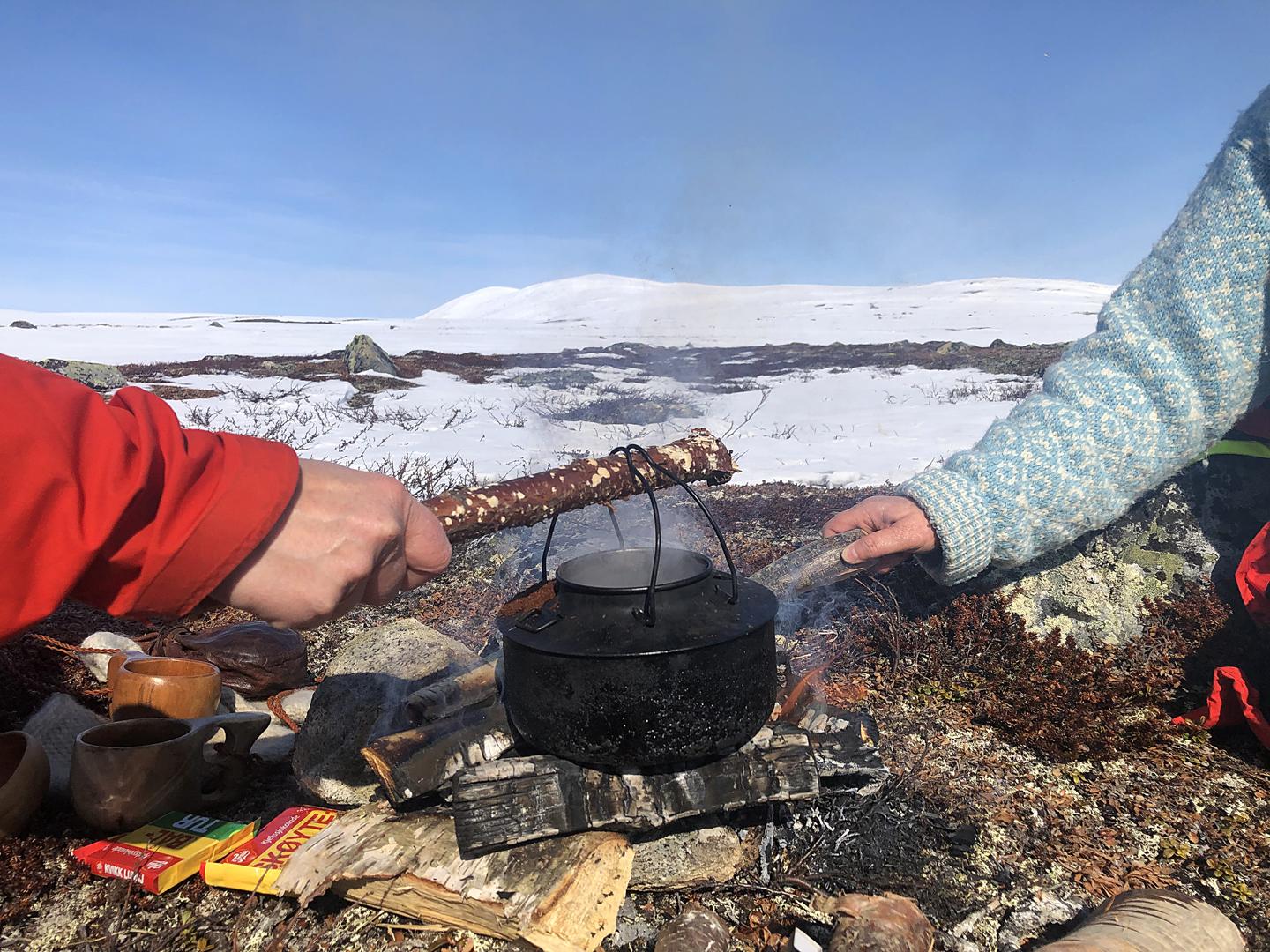
For more than a hundred thousand years, people have made fires as it makes one feel safe and warm. The activity is deeply rooted as tacit knowledge in both our shared arctic culture and landscape. In our performance, we use the tradition of making coffee on a bonfire to connect people and give a sense of belonging to our Arctic region. In this art-based investigation, we ex-changed knowledge with each other, local people and visitors in the Arctic.
Text: Karin Stoll, Wenche Sørmo and Mette Gårdvik, Nord University, Norway
Cover photo: Figure 1. The art of making Campfire Coffee, Saltfjellet, Northern Norway. Photo: Mette Gårdvik, 2023.
Info
The performance team consisted of Karin Stoll, Wenche Sørmo and Mette Gårdvik at Nord University, Faculty of Education and Arts. Participants were the writers, colleagues in AEA and people who stopped and sat down with a cup of coffee by the fire on the main street in Bodø at the UArctic Congress 2024. The workshops were arranged from 2023-2024, and the place and setting for the performance varied.
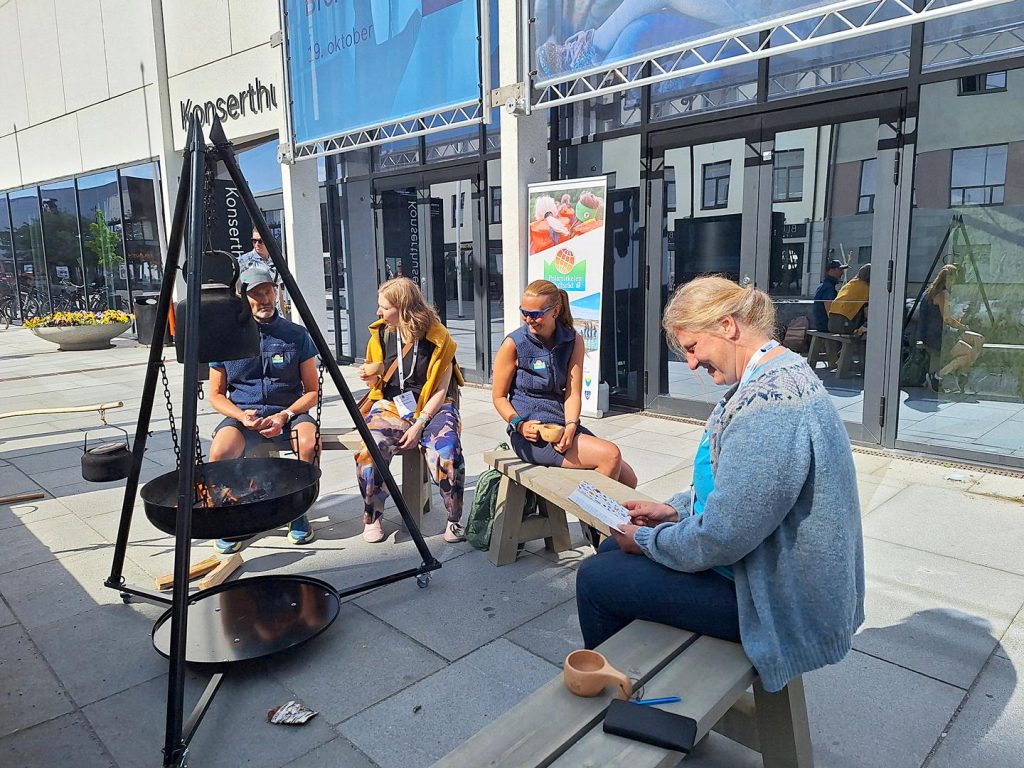
One aim of the cooperative project, New Genre Art Education in the Arctic, is to create a platform for new collaborations in Art-based support of sustainability, social justice, and well-being for all citizens in communities in the Arctic, through dialogical and participatory art-based methods. Campfire coffee is a beloved and timeless tradition among the people of the North and provides a unique, warming, and social experience in nature (Ryd, 2018). In social settings around a warm fire with a black pot in the centre, people often start talking and telling stories. In this way, campfire coffee helps create an atmosphere and framework for sharing stories, knowledge and exploring one’s own identity. In this performance, we wanted to share this tradition to embrace and promote respect and cultural sensitivity for the Northern way of living and invited participants to exchange experiences and gain insight into each other’s lives by the fire.
The performance was carried out in different places and settings, first on Saltfjellet in Northern Norway in May 2023, beneath the Arctic Circle at the beginning of our journey to Greenland, where we would meet our partners in New Gender Arctic Art Education for the first time (Gårdvik, et al., 2023). By the fire, we reflected on our understanding of “North” and “the Arctic” and elaborated on the meaning and importance for us while enjoying campfire coffee in our traditional wooden cups (koksa). When we met our colleagues in the AEA-project in Nuuk, we picked up the thread and lit a new campfire on a stroll in the mountain Lille Malene, Quassussuaq. By doing this, we wanted to facilitate sharing stories about our common Arctic landscapes, cultures, identities and traditions. The performance was part of the New Genre Arctic Art and Art Education exhibition in Bodø, 2024, with a live performance outside the gallery for people passing by the busy street in the city centre. In the social setting around a warm fire with a black pot in the centre, people spontaneously stopped and joined the campfire event. They got a cup of coffee in a “koksa” and shared their good stories from experiences with bonfires and campfire coffee with the campfire community.
Our performance was based on the tradition of making coffee on a bonfire, an activity that embraces and promotes respect and cultural sensitivity, as well as cultural, environmental, and social sustainability in the Arctic landscape. The concept refers to our way of being and dwelling, and the tasks we perform in our daily landscapes (Ingold, 1993). This is deeply rooted as tacit knowledge in our shared culture in the arctic landscape.
References
Ingold, T. (1993). The temporality of landscape. World Archaeology Vol. 25, No. 2, Conceptions of Time and Ancient Society (pp. 152–174). Taylor & Francis.
Gårdvik, M., Hoffman, G., Stoll, K. & Sørmo, W. (2023). Campfire Coffee on Saltfjellet. Retrieved from: Campfire Coffee on Saltfjellet – YouTube
Ryd, Y. (2018). Bål. Samisk ildkunst [Fire: Flames and Embers. Sámi
Fire Art]. Dryer forlag.