
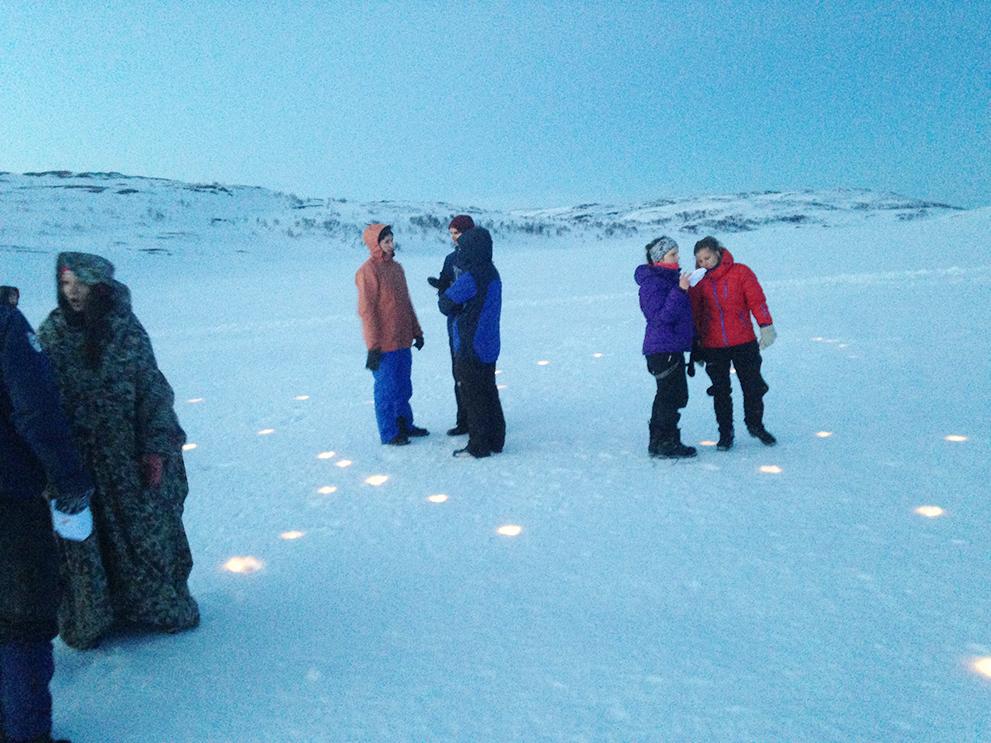
In this interdisciplinary workshop we used artistic and inquiry-based methods to engage participants in the Sámi mythology of the starry sky. Despite that the Sámi story about a cosmic hunt is closely connected to our way of living as Northerners, it is less known than the Greek mythology. An authentic setting contributed to connect people and communities under our common starry sky.
Text: Mette Gårdvik, Karin Stoll and Wenche Sørmo, Nord University, Norway
Cover photo: Figure 1c. A cross-country ski tour in Sami locations starting from Sijti Jarnge, a Sami language and cultural center in Hattfjelldal in North Norway. We had a workshop at Krutvatnet, a lake, making a light installation with teacher students in April 2013. Photo: FarOutFocus, H.P. Sørensen, 2013.
Info
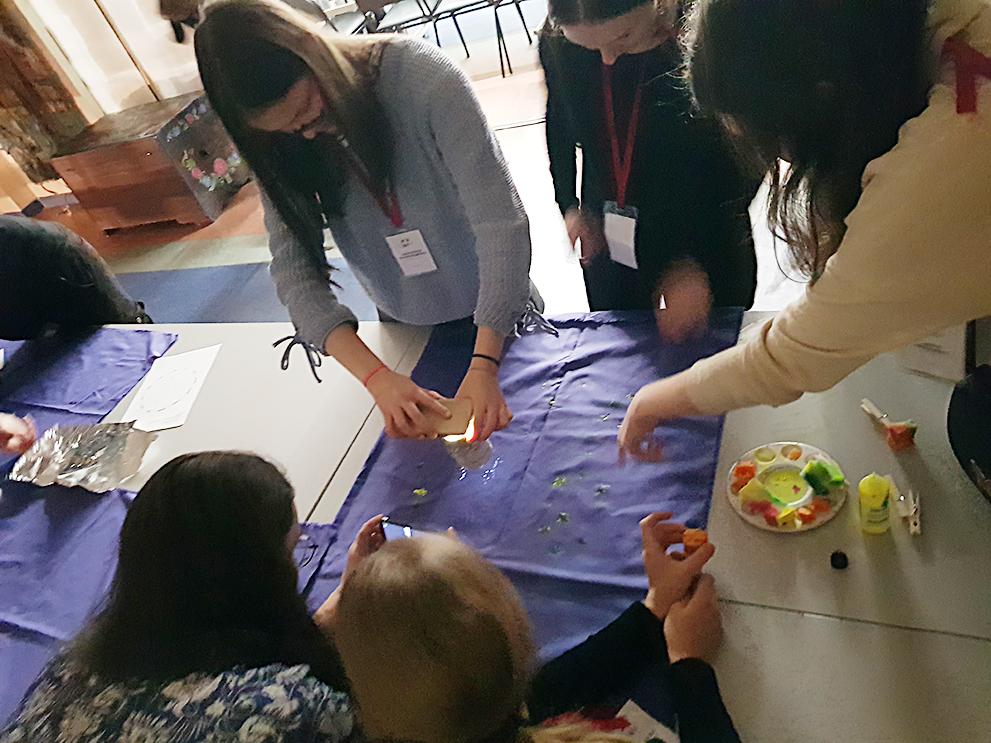
The Workshop team consisted of Mette Gårdvik, Karin Stoll and Wenche Sørmo at Nord University, Faculty of Education and Arts.
Participants were teachers (Norwegian and Swedish), teacher students, pupils aged 11-16 in northern Norway and Alaska, and Russian art students.
The place and setting for the workshops varied, but we strived to arrange a holistic and authentic setting outside with a bonfire, storytelling, tasting of reindeer meat and using the star map to navigate the sky to find the location of the constellations.
The workshops were arranged from 2023–2024.
Together with Professor Gary Hoffman we made a short film, showing how we have been arranging workshops with the Sámi myth of the starry sky as a theme (https://www.youtube.com/watch?v=M62swt2BOzE).
Our common cultural heritage in Sápmi has developed throughout history and must be managed from a socio-cultural sustainability perspective by both living and future generations. Sámi cultural heritage is part of Norwegian cultural heritage (UN`s ILO-Convention 169, 1989). Educational systems must integrate Sámi perspectives in all teaching to contribute to the development of identity in an inclusive community (KD, 2017). Teaching about Sámi culture and tradition is a natural part of the curriculum in Norwegian teacher education.
We have developed, carried out and evaluated interdisciplinary teaching activities about the Sámi mythologies of the starry sky to decolonize from Western culture and implement the activity in educational systems in the Arctic region (Sørmo, et al., 2019).
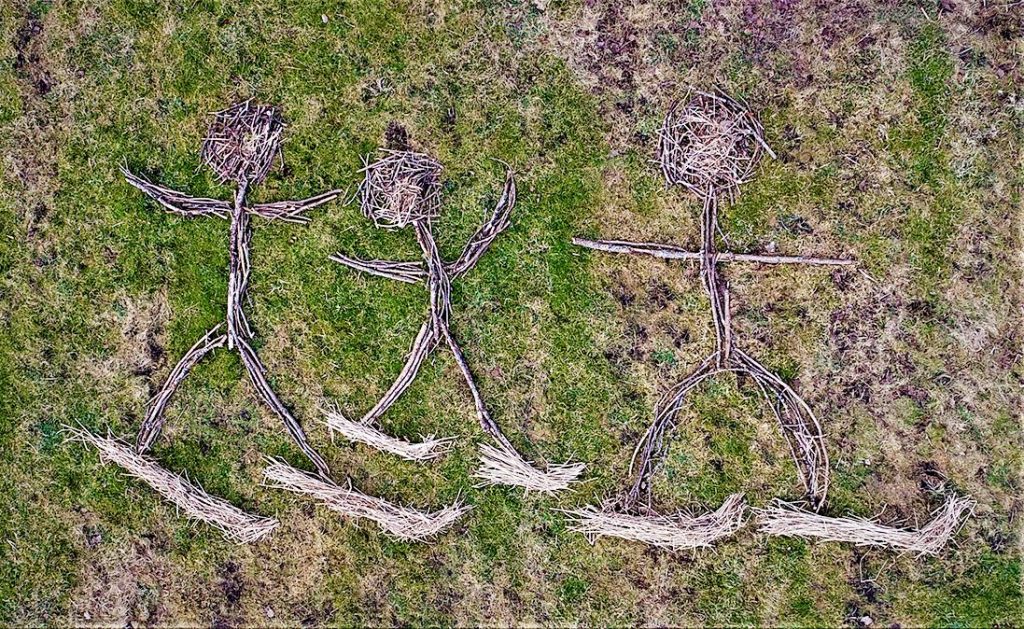
The Sámi mythology describes a hunting scene, where several hunters and other actors, represented in different star constellations, participate in a cosmic hunt after a moose/reindeer (Sarvves). The big ungulate grazes peacefully across the sky and avoids being killed due to the position of the North star (Stella Polaris), which according to the myth, holds the sky in place. If it is destroyed, the sky will fall (Sergejeva, 2011; Nord-Norsk Vitensenter u.d.). The hunters can therefore not get a good aim at their prey, and the hunt continues infinitely.
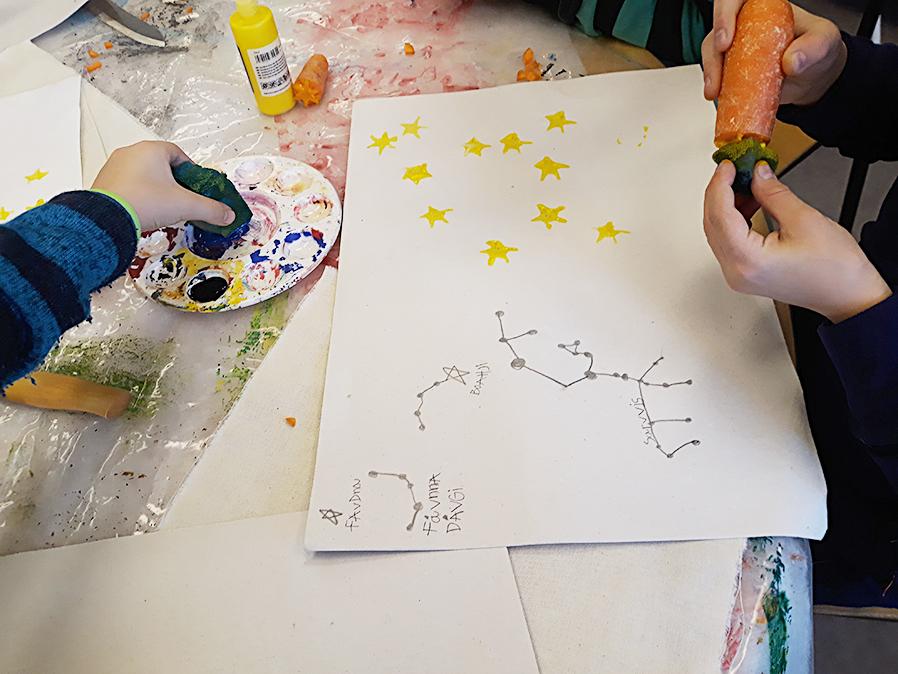
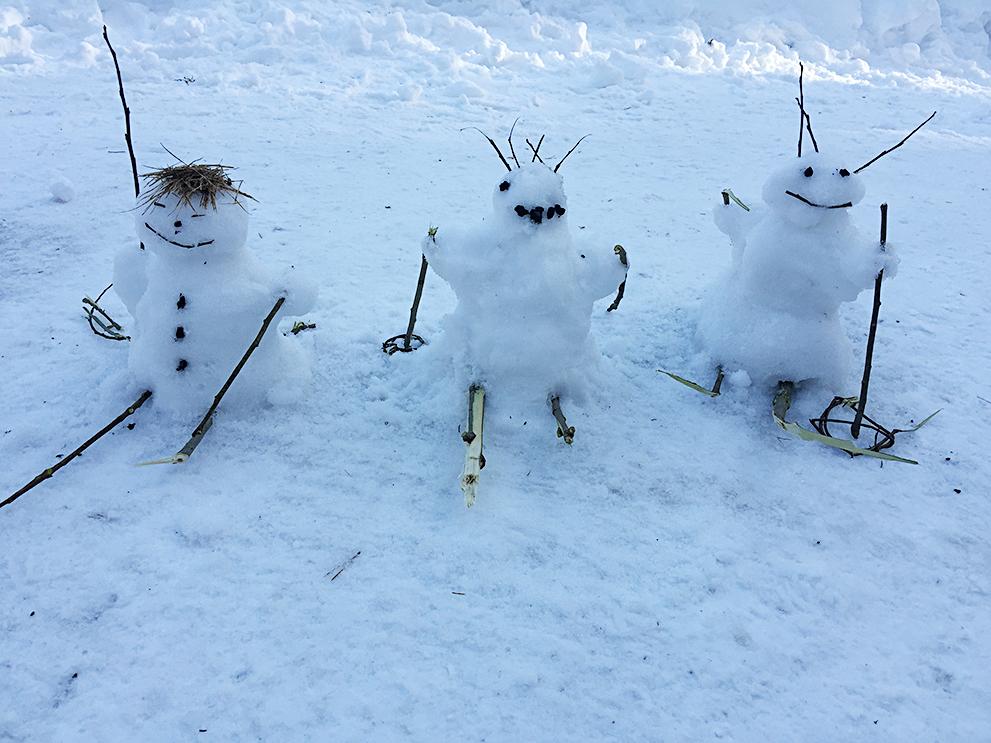
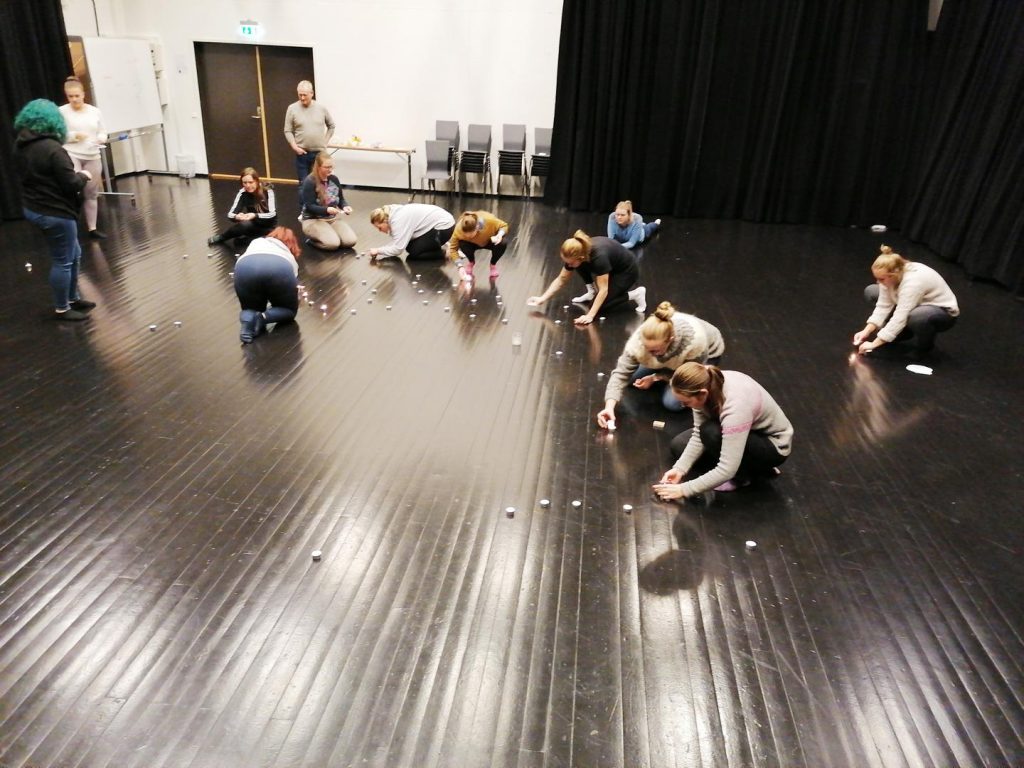
In the art-science integrated workshop, the theme opens for teaching in natural science about the history of the universe, what a star is, and about the planets in our solar system. In a cultural setting, the story helps to recognize the position of the different hunters and Sarvves in relation to each other and to Stella Polaris. In this way, the participants get an understanding of how Sámi and northern people could navigate and hold track of time in the dark season without modern technology. Participants learn how to make and use a star map, to learn and recognize the names and the shapes of Sámi star constellations and how to navigate with the starry sky. We use Sámi myths about star constellations but are open to participants’ stories and knowledge of other myths connected to star constellations in the north. Participants get to know the Sámi constellations by practical-esthetical exploratory working methods, using drawing, dramatization, making their own “star gazers” with one or several of the actors in the hunt, and by using stamp printing by carving out star shapes in vegetables to print the constellation on cloth or reindeer skin. We invite participants to engage in Land Art by working together using available natural materials or lights to recreate the hunting scene from the mythology using the star map. The activity seems to engage pupils, students, and teachers, especially in the outdoor activities when participants are challenged to project the hunting scene from the star map onto the ground. A holistic and authentic setting and being outdoors is important for the activity to engage and to be remembered.
The myth about the Sámi starry sky is deeply rooted in our northern way of life and the participants get the opportunity to reconnect to this part of our common cultural identity through artistic expression. The workshop is clearly rooted in the Arctic since we Northerners experience the same seasons and the same star constellations and could bring people from different cultures together to share their stories and mythologies. In this way, the workshop contributes to a New Genre Art Education in the Arctic.
References
Kunnskapsdepartementet (KD) (2017). Overordnet del – verdier og prinsipper for grunnopplæringen. Fastsatt som forskrift ved kongelig resolusjon. Læreplanverket for Kunnskapsløftet 2020 [The national curriculum in Norway 2020]. https://www.regjeringen.no/contentassets/53d21ea2bc3a4202b86b83cfe82da93e/overordnet-del—verdier-og-prinsipper-for-grunnopplaringen.pdf
Nordnorsk Vitensenter, (u.d.). Lag et stjernehjul. [Make a star wheel.] Retrieved from https://nordnorsk.vitensenter.no/stjernehjul
Sergejeva, J. (2011). Nokre samiske stjernebilete: Eit jaktfolks forestellingar om stjernehimmelen. [Some Sámi constellations: The hunting people’s ideas about the starry sky.] https://www.mn.uio.no/astro/tjenester/publikum/almanakken/innhold/tema2001.html
Sørmo, W., Stoll, K. & Gårdvik, M. (2019). Starry Sky – Sámi mythology: Inspiration for collaborative artistic expressions and learning. In T. Jokela & G. Coutts (Eds.). Relate North: Collaborative art, design and education (pp. 13–19). InSea publications.
UN (1989). C169 – Indigenous and Tribal Peoples Convention (No. 169). Convention C169 – Indigenous and Tribal Peoples Convention, 1989 (No. 169) (ilo.org)