
Defining Moose Browsing Damage in Finland & Sweden
In the northern forest, snow squeaked under the hoofs of a moose as it walked between waist-high pines. Morning mist vailed pines in the distance, revealing glimpses of amber. Air filled with the smell of resin. Hunger had etched a story in the saplings, written in broken tops and scarred stems.
Let’s start with something everyone in forestry agrees on: moose browsing is no small issue. Every winter, countless pine seedlings and young birches face the same fate; a hungry moose looking for food. But here’s the catch: while everyone can recognize the chewed tops and bent stems, what counts as “damage” depends on where you stand.
Finland and Sweden share a border, similar forest types, and considerable moose populations. Yet, when you ask a Finnish forester and a Swedish one to define “moderate browsing damage,” you might get two slightly different answers. And those differences ripple through how each country manages forests and wildlife.
Finland
The Finnish National Forest Inventory (NFI) gives systematic and general view on condition of Finnish forests. The NFI is based on statistical sampling and field measurements, covering approximately 60,000 sample plots across Finland within a five-year period. Moose damage monitoring in NFI began in 1986, and results are available at the regional level, though damage data remain sparse and variable between years.
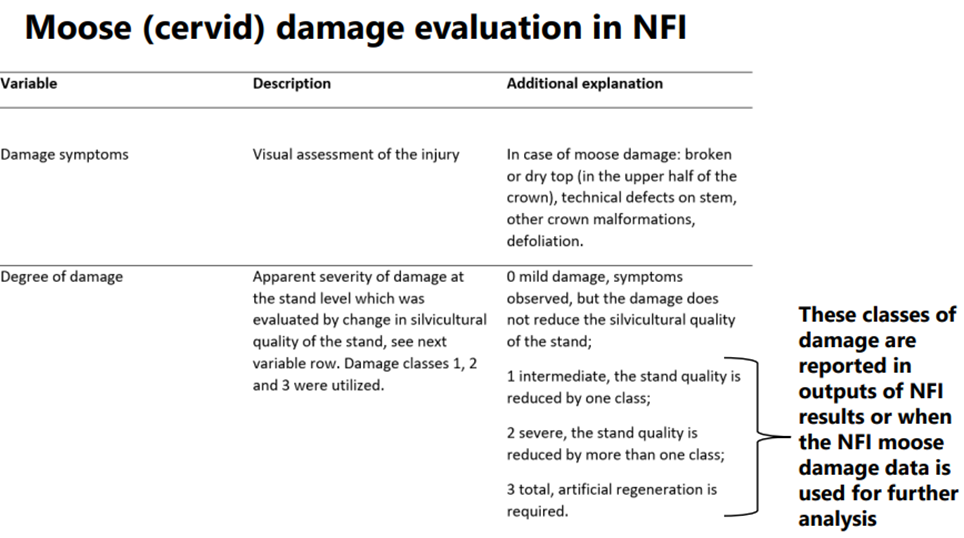
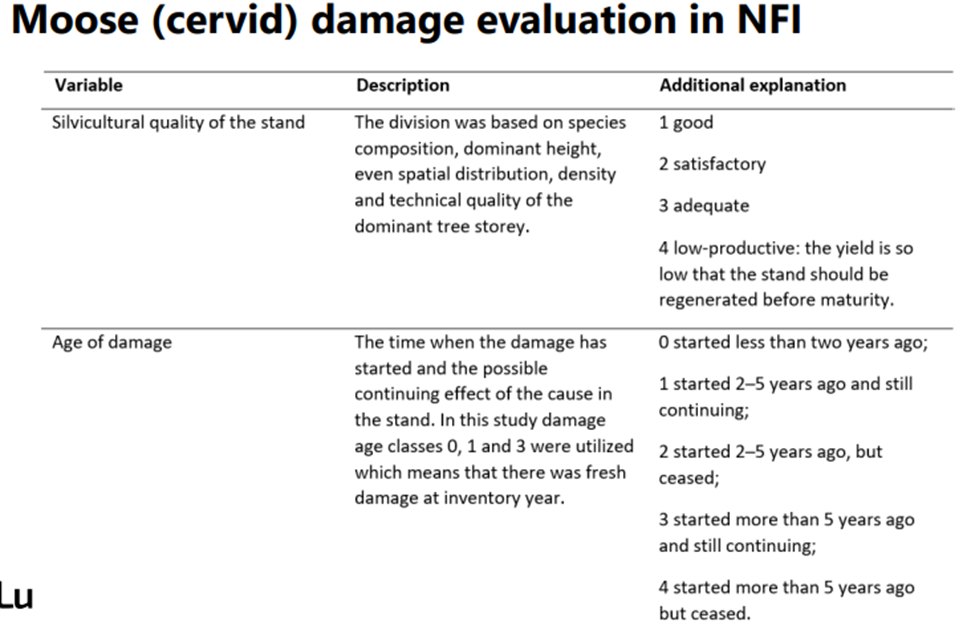
Damage in Finnish NFI data is determined at stand level and categorized by severity into classes “intermediate,” “severe,” or “total.”. The classification hinges on the extent of top shoot loss, stem deformation, and long-term effects on growth potential. A single browsing event might be minor; but repeated top losses that cause forking or height stagnation on many seedlings move stand damage into more serious classes.
Finland uses also another method to gather browsing damage data for unique compensation system for cervid damage. The Finnish compensation system for cervid-related damage is based on the Game Animal Damage Act (Riistaeläinvahinkolaki). Compensation may be granted to private landowners whose forests, crops, or livestock have been damaged by cervids.
The Finnish Forest Centre (Metsäkeskus) acts as the assessment authority and makes the compensation decisions. In field assessments, inspectors evaluate damage to seedlings and trees, including injuries to stems, branches, needles or leaves, and bark. Damage is classified into two categories. Class I: healthy or slightly damaged trees and class II: severely damaged trees.
Compensation is calculated based on the ratio of severely damaged trees to healthy trees prior to the incident. The assessment also considers site location, area, forest type, tree species, and number of seedlings. If re-establishment of the stand is necessary, reforestation costs are also covered.
These systems feed directly into the country’s moose management policy, tying local field observations to regional and national decision-making through standardized data. For this purpose, regional predictions for moose damage based on NFI-data are available at https://luonnonvaratieto.luke.fi/numerotieto/raportit?panel=hirvituhot&lang=en.
Sweden
While Sweden’s practices resemble those in other Nordic countries, their tolerances and moose population densities vary. The Swedish Äbin inventory, short for Älgbetesinventeringen (Moose Browsing Inventory), is managed by the Swedish Forest Agency (Skogsstyrelsen).
It’s a large-scale system that collects annual data on young regenerating stands, focusing primarily on pines about 1–4 meters tall. It covers approximately 45,000 sample plots and 12,500 young forest stands annually across moose management areas exceeding 100,000 hectares. Inventory’s goal is to maintain a balance between the moose population and forest regeneration. It’s the main tool used nationwide. It tracks browsing on pine and other tree species by looking at both frequency and intensity, much like Finland does.
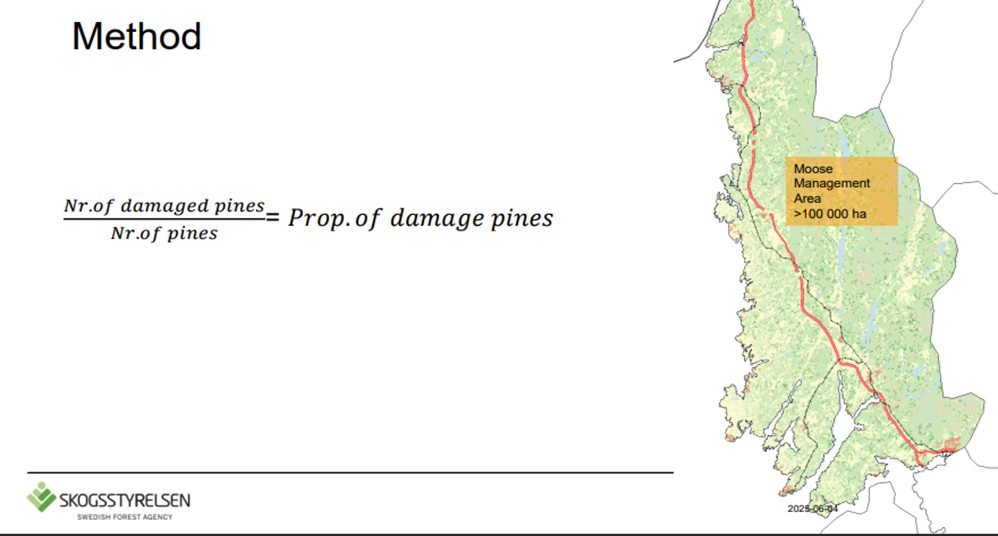
In Swedish forestry, the acceptable damage levels are defined as follows: For pine, an annual damage rate of no more than 5% and at least 85% of trees intact. For spruce, a damage rate below 1%. Moose browsing also influences forest succession, accelerating the spread of pioneer broadleaved species (such as rowan, aspen, willow, and oak) at the expense of conifers. Äbin helps quantify how much of the young forest (of economic interest) is affected by browsing, which is a key variable in setting harvest quotas, protective measures, and forest regeneration planning.
Sweden also integrates browsing assessments directly into moose population management. The idea is that forest and game managers should share a single, balanced view of what’s acceptable browsing pressure. If damage levels exceed agreed limits, local moose population targets are adjusted.
Same forest, different story
You’d think that two countries with so much in common would describe and take inventory of the damage in roughly the same way. But that’s not quite how it goes.
In Finland, a stand classified as “moderately damaged” might be considered “lightly browsed” in Sweden. That’s not because someone’s wrong, it’s because they’re measuring and taking account slightly different things.
These small differences shape how we talk about the problem. Finland tends to highlight forest productivity and compensation mechanisms. Also, NFI data isn’t produced annually. Sweden talks more about ecological balance and adaptive moose management, and Äbin data is annual. Both are valid, but they lead to different decisions on the ground and in the policymakers’ halls.
Why definitions matter more than ever
Now, you might wonder: why does this matter so much? Isn’t chewed pine just chewed pine?
Well, not exactly. The way we define damage affects everything from management strategies to policy outcomes. It guides compensation schemes, shapes public perception, and determines how we evaluate the success of moose population control.
And with climate change, the context is shifting again. Warmer winters, shifting snow patterns, and changes in moose behavior are already altering browsing patterns. In southern Finland and parts of Sweden, milder winters mean moose may spread browsing pressure more evenly, or in some areas, keep feeding longer into the season.
So, when the baseline itself is changing, having comparable monitoring framework across borders isn’t just a bureaucratic dream. It’s a necessity for adaptation planning.
Several collaborative efforts have started to come up to bring Finnish and Swedish perspectives closer together. One of them is The Interreg Aurora’s “ClimateForest” project. Project’s webinars have already sparked dialogue between agencies and researchers. For example, webinar on the 3rd of June 2025 had many participants from Finland and Sweden mentioning that their inventory systems had flaws and limitations. Finding a common ground with different stakeholders in-land and abroad was thought essential along with more research and cross-border cooperation on the topic.
I would say that the goal isn’t to erase national differences. It’s to make collaboration smoother and develop translation tools between systems. It’s aligning perspectives on what’s acceptable, what’s tolerable, and what needs action. Shared indicators, harmonized thresholds, or even parallel plots could help ensure that “moderate damage” means roughly the same thing on both sides of the border. When foresters from both sides of the Tornio River can look at a stand and agree on what “moderate damage” really means, management discussions become much more meaningful.