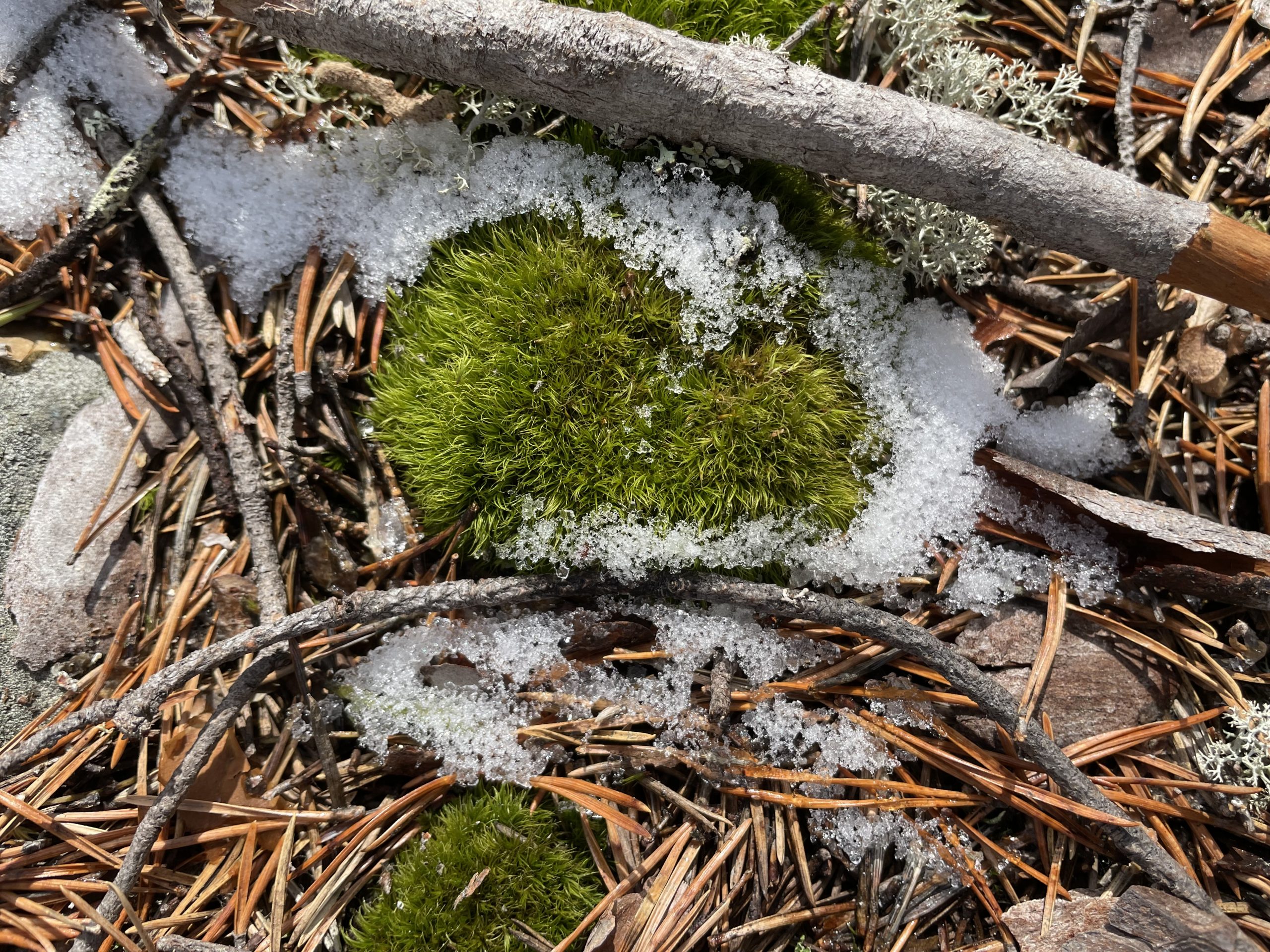
Playing with the present in Pyhä
Text: Daijiro Yamagishi, Juulia Tikkanen & Anna-Emilia Haapakoski, University of Lapland
Video: Yue Hu, University of Plymouth
*This blog post is based on the One By Walking network's workshop in Finnish Lapland, hosted by the Intra-Living in the Anthropocene research group. It’s written by PhD students Anna-Emilia Haapakoski, Juulia Tikkanen, and Daijiro Yamagishi, and takes inspiration from three activities we took part in: An Introductory Walk: A Taste of Pyhä (guided by Outi Rantala), Walking Futures at Keropirtti Kota (led by Camilla Brudin Borg), and Audible Walking (with Neal Cahoon, Dominica Williamson, John Martin, and Yue Hu). Our reflections also draw on conversations with fellow participants Noel B. Salazar and Emily Höckert. We are thankful for the insightful collaboration with all of you!
The academy can often be executive, even hectic, leaving little to no room for idleness. Within the concrete walls of the academic world, one might easily lose freedom of thought without even noticing. In the institutionalised system where academics seek rigorous arguments, publish numerous articles, produce applicable information for industry use, and familiarise themselves with the most relevant literature, the pace of a researcher’s work is set. For most of the year, white lecture halls, cluttered office spaces, and coffee-scented meeting rooms hold us captive. While our freedom to think in academia is not restricted by a rule, the metrics of academia, including funding instruments, hierarchies, and expectations, might result in something that feels like pressure (Spooner, 2024). Performance-based national funding systems often place academics in a situation where they compete, rather than collaborate, with each other to secure a research budget, advance careers, and publish more articles to stay competitive (see Ylijoki et al., 2024; Spooner, 2024). This situation is not unfamiliar in other fields of work, where employees likewise strive to perform as efficiently as possible to reach the productivity goals set by management. It is normal. It is exhausting.
These four days at the end of April 2025 are different. We are at the core of Pyhä-Luosto National Park, formed by the southernmost line of fells in Finland. This area serves a variety of purposes, including nature conservation, local community use, hiking, and tourism. We feel the wind in our hair. We hear the forests whisper their secrets. Our research station (the Keropirtti cabin) is situated right on the border of the national park area. We are lucky to come here for work every now and then. We even have a small pond behind the window, freckled with rays of sun and fallen pieces of tree bark.
This time, we brought friends with us: the One By Walking (OBW) network. The multidisciplinary network OBW, comprising scholars from fields such as pedagogy, social sciences, humanities, and performing arts, was founded in 2020, aiming to collaborate, discuss, and experiment with research methodologies concerning walking (One By Walking, n.d.; see also Borg et al., 2025). We are excited to host and be hosted by our fellows at the cabin. Here we do the chores together, network together, go to the sauna together, and some of us even sleep next to each other on the upper floor that still holds the memory of the time when this cabin was an Inn for travellers. Here we are, one – not just by walking, but by our shared household chores – like the great responsibility of cooking dinner for each other or heating up the sauna in the evening.
Since the network launched, a series of walking workshops have been held in both physical and virtual environments. The network includes senior and early-career academics and artists, united by their interest in the practice of walking. Unlike an established organisation, this network exists in the form of open-ended “gatherings”. Becoming more than a collaboration of individuals to achieve a united goal, it is a practice that creates space for diversity, movement, and new imagination (see Tsing, 2015). Like mushrooms, we pop out as a collective on the prosperous grounds of Pyhä, happy to share our resources and ideas for the cultivation of different directions of growth and academic adventures. We appreciate walking as a way to be present with and attentive to our surroundings. Walking as a method is also rooted in feminist new materialism theory and thus emphasises movement as a form of knowledge-making (Rantala et al., 2020).
Video: Yue Hu
Roaming listeners and creative pirates
In contrast to the goal-oriented Epoch of efficiency, “the modernity”, our gathering in Pyhä enjoys uncertainty, unpredictable events, and unexpected encounters – the process rather than the outcome, the journey before the destination. In these moments, the limitations of the conventional academic world become tangible. How can we learn if we are already set on the answer? If the rules of academic conventions remind us to stop dreaming and only focus on the goal ahead. In the history of science, the line between fantasy and reality has been like suggesting a world without weapons. Someone will stop you right there, “that is utopia”, suggesting that we should drop the thought altogether.
Luckily, we are gathered in Pyhä. This is a safe place to play, and today we play with the present. Not knowing what’s next, our workshop consists of three simple activities: walking, listening, and imagining. Walking, listening, and utopian thinking through gathering are relational methodologies for knowledge-making (Rantala et al., 2024). These differ from “knowledge production”, as they do not aim to extract information or establish fixed representations or theories (Taylor, 2021). We spent the whole day outside. We roam in the forest. Lie ears pressed on the bilberry leaves. We move pinecones and branches around, and one of us even catches a paw print from the snow cover. We stay silent and listen to the mire, tree trunks, moss, and snow. It is not only fun, but this is also an act of deep, attentive listening, which Kumi Kato (2015, p. 113) might call “honouring the other”—creating a space for various others to express themselves and be heard. After listening and recording tiny sounds with special microphones guided by Neal Cahoon, Dominica Williamson, John Martin, and Yue Hu, we make small exhibitions on the mire-side to (re)present our findings to the other groups.
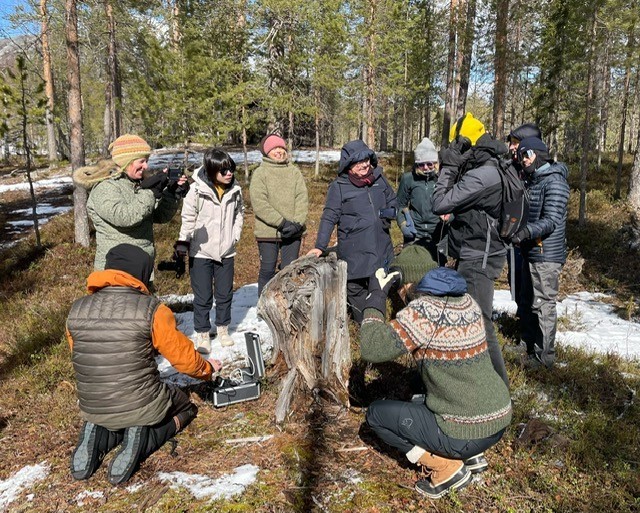
Sounds of the forest (Picture: Emily Höckert)
In the afternoon, the cabin becomes a pirate ship, thanks to Camilla Brudin Borg’s utopia assignment. Sitting in front of the fireplace, we move from ship to ship. There is no more land in sight. The water surface is high due to climate warming. The year is 2070, and we are on a mission. We are a group of pirates confiscating “bad science” and “bad art”. We draw a map. The treasure is marked with a red X. Pink Beard is the captain of the crew. Right Hand is their first hook. Blue Scout is the sneaky one; they go first and scout the environment, find out what’s going on, and assess the situation. Brown Shadow is the best swimmer and can breathe underwater, which comes in handy when the crew needs to access the underwater volt. We get to decide what it is that we find from the red X, too. We find a treasure chest that can translate “bad science” into good ideas, happiness, and kindness. Other groups find cool things, too, and we are excited to learn from their stories. It feels like we are kids, just making things up after another. We get to decide how the stories go. Even though the start setting is challenging with the high sea level, we get to choose a way forward. It does not have to be realistic. There are no limits to consider. We can focus on imagining and acting upon that imagination.
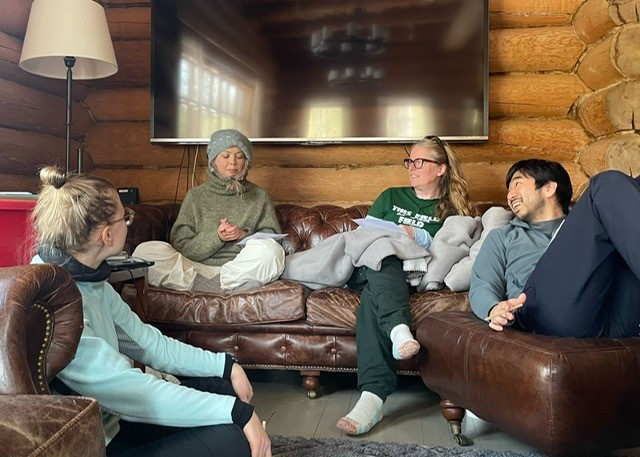
The pirates (Picture: Emily Höckert)
Practical utopias
Although the games we played might not seem practical right away, they got us thinking about how we could consider utopias more practically – how can we walk forward from here with these thoughts in our pockets? Keijo Lakkala (2021, p. 28), for one, considers them as “critical counter-images of the present motivated by a desire for a better being”. The first component of the definition, “a critical counter-image”, emphasizes the critical function of utopias: the second, “the present”, expresses the relationalist position of the definition, which fosters critical thinking and encourages envisioning alternative ways of living; the third, “desire for a better being” follows the work of Ruth Levitas’, which refers to utopias not being perfection but a remarkable better of being. Levitas (2017) argues that through utopias, we can look from the present to the future but also from the future to the present. Therefore, we see that utopias are not just about futures, but about the present. The present can always be envisioned as being different, and the present does not dictate what the future will be but can result in various possible futures based on the decisions made in the present (Lakkala, 2021).
In the current time, when everything humans do seems to accelerate the ecological crisis, utopian thinking can open up possibilities and spaces that facilitate social change by questioning society’s existing collective goals (see Eskelinen & Lakkala, 2024). However, instead of seeing utopias as a blueprint of an ideal or perfect society (Lakkala, 2021), they can be understood as a “critical-creative method of thinking differently” (Borg & Skelton, 2024, p. 4). Whereas utopias are often seen as – well, utopian – they seem to hold a lot of potential also in front of practicality. What is the function of utopias? Utopias help us to free ourselves from the chains that hinder our ability to think and explore speculative, fictive, desirable, and unwanted future narratives. They do not limit us to choosing one thing to change but allow us to imagine entirely different societies (Levitas, 2017). To envision alternative viewpoints for the futures, utopian narratives need to be able to put aside notions of what appears to be realistic and plausible – “the plausibility requirement” restricts the storyteller’s ability to discover novel, norm-breaking and potentially disruptive future scenarios (Borg & Skelton, 2024, p. 4). And who is to say that what is “only” fictive today cannot become reality someday, if we can imagine it, perhaps we can walk the way.
Departure day reflections
After the weekend, our steps feel a bit lighter. With Camilla Brudin Borg’s words, we will “carry this weekend as a light in our hearts”. We are waiting for departure, and all the bags are packed. After the shared time of academic freedom, we still have time to browse through Dominique Williams’ materials from her art-based workshops and methods carried out across various rural regions (see Martin et al., 2021). We appreciate the transdisciplinary nature of this network, where there is space for learning and inspiring one another in mutual ways. Amazed by the pictures of pirate ships and others drawn by the children, we start to reflect on why adults find it so hard to play—at what point in life do we lose the part of us, what part is it? One of us notes how even visualising tasks with students is usually limited to sketching quick stick figures. We ponder upon the thoughts. Maybe some of it is lost in the practical skill of drawing and use of colours, some of it might be thinking through usefulness, saving time, not even daring to try and waste it… It is just faster and easier to draw stick figures than to invest the time it takes to paint a landscape, a whole world, from scratch, creating an imaginary world and filling it.
Another important thing we discuss on the drive back is the safety we always experience in Pyhä. Like the word “pyhä”, which means “sacred” in English, this is what this cabin and the surrounding forest offer to us: a safe place to be vulnerable, to be silly, to be creative. We can be who we want to be. At first, the story of “bad science” confiscating pirates might not seem helpful. And maybe it is not the most useful story to share either. However, who gets to define useful, the ends we compare our means to? What is the use of ridiculing utopias, when they can actually be our way towards safer, perhaps even sillier futures? Utopias also offer us a possibility for knowledge-making and resistance. This kind of experimental and open-ended learning we got to enjoy is often dismissed in the current knowledge-making institutions, while in contrast, they operate in environments under control. Within this same condition, knowledge risks becoming a product, a commodity, or intellectual property that teachers can transmit to students. This academic model contributes to providing for the scientific advancement scheme, which is based on exceeding the level of its predecessors (Ingold, 2022, p. 13). Although the positivistic knowledge production guidance can provide a clear linear path to follow easily, this model also leads to standardisation and homogenisation of knowledge, which potentially excludes the possibility of alternative and even free thinking (Valtonen & Rantala, 2020). Instead, we appreciate wandering without a pre-set destination, not knowing always where to go, and embracing the possibility of getting lost.
Like the pirates confiscating science and art that led to the alarmingly rising sea level in 2070, we might want to slow down in the present to imagine ways out of this future that we can start walking towards. With a scientific fabulation method, unlike traditional scientific papers, Emily Höckert (2025, p. 313) encourages us to “call for openness, curiosity, and wonder towards alternative ways of being in the world”. Additionally, we need more space to value the creation of mutual and meaningful relationships over strategic collaboration and academics, to trust and enjoy the process rather than chasing the outcomes. What we experienced in Pyhä through the One by Walking gathering is already a process of knowledge-making that is an ongoing action, practice, event, and encounter, embracing the active presence of this creative work of science that we are entrusted with.
We continue walking with utopias.
References
Borg, C. B., & Skelton, A. (2024). A critical utopian shared socioeconomic pathway. Futures, 163, 103437. https://doi.org/10.1016/j.futures.2024.103437
Borg, C. B., Åberg, H. E., Norum, R., Österlund-Pötzsch S., & Martin J. (Eds). (2025). One by Walking: Transdisciplinary mobilities and methodologies. Bloomsbury.
Eskelinen, T., & Lakkala, K. (2024). Images of the present and possible: Analyzing the climate movement through its utopias. Sociological Research Online, 1-18. https://doi.org/10.1177/13607804241257745
Höckert, E. (2025). 83: Scientific fabulation. In P. Eriksson, T. Montonen, P. Laine, & A. Hannula (Eds.). Elgar Encyclopedia of innovation management (pp. 312-313). Edward Elgar Publishing.
Ingold, T. (2022). Introduction: Knowing from the inside. In T. Ingold (Ed), Knowing from the inside: Cross-disciplinary experiment with matters of pedagogy (pp. 1-19). Bloomsbury.
Kato, K. (2015). Listening: Research as an act of mindfulness. In K. Gibson, D. B. Rose, & R. Fincher (Eds.), Manifesto for living in the Anthropocene (pp. 111–116). Punctum Books.
Lakkala, K. (2021). Utopia as counter-logical social practice [Doctoral dissertation, University of Jyväskylä]. https://jyx.jyu.fi/jyx/Record/jyx_123456789_78576
Levitas, R. (2017). Where there is no vision, the people perish: a utopian ethic for a transformed future. CUSP Essay Series on the Morality of Sustainable Prosperity, No 5. Guildford: Centre for the Understanding of Sustainable Prosperity. https://www.cusp.ac.uk/wp-content/uploads/05-Ruth-Levitas-Essay-online.pdf
Martin, J., Williamson, D., Łucznik, K., & Guy, J. A. (2021). Development of the my cult-rural toolkit. Sustainability, 13(13), 7128. https://doi.org/10.3390/su13137128
One By Walking. (n.d.). About Us: Walking as a methodology. Retrieved September 3, 2025, from https://www.onebywalking.net/about-1
Rantala, O., Kinnunen, V., & Höckert, E. (2024). Researching with Proximity: Relational methodologies for the Anthropocene. Springer Nature Switzerland. https://doi.org/10.1007/978-3-031-39500-0
Rantala, O., Valtonen, A., Salmela, T. (2020). Walking with rocks – with care. In United Kingdom: Edward Elgar Publishing. In A. Valtonen, O. Rantala, & P. D. Farah (Eds), Ethics and politics of space for the Anthropocene (pp. 35 -50). Edwards Elgar. https://doi.org/10.4337/9781839108709.00008
Spooner, M. (2024). Qualitative research and global audit culture: The politics of productivity, accountability, and possibility. In N. K. Denzin, Y. S. Lincoln, M. D. Giardina, & G. S. Cannella (Eds.), The Sage handbook of qualitative research (Sixth edition; pp. 894-914). SAGE.
Taylor, C. A. (2021). Knowledge matters: Five propositions concerning the reconceptualization of knowledge in feminist new materialist, posthumanist and postqualitative approach. In K. Murris (Ed), Navigating the postqualitative, new materialist and critical posthumanist terrain across disciplines: An introductory guide (pp. 22-42). Routledge.
Tsing, A. (2015). The mushroom at the end of the world: On the possibility of life in capitalist ruins. Princeton University Press.
Valtonen, A., & Rantala, O. (2020). Introduction: reimagining ways of talking about the Anthropocene. In A. Valtonen, O. Rantala, & P. D. Farah (Eds), Ethics and politics of space for the Anthropocene (pp. 1 -15). Edwards Elgar.
Ylijoki, O., Hokka, J., Kurtti, E., Olsson, P., & Suopajärvi, T. (2024). Tiede ja tunteet: Tutkimustyön arki ja arvot kilpailuyliopistossa. Gaudeamus.