It finally happened! This staff member of the eLearning Centre of Kemi-Tornio UAS completed a MOOC. Well, to be exact, I completed two simultaneously! 🙂 A MOOC is a Massive, Open, On-line Course. The model was developed in the past few years and it had its breakthrough in 2012. The idea behind it is to offer high-level education, for free, to very large student populations worldwide via the Internet. The biggest MOOCs have more than 100 000 enrolled students. This implies that contact between teachers and students must necessarily be very limited and this, in turn, increases demands on the course material to be interactive. There are two main approaches to this. One is crowd-sourcing, in other words the students teach each other with a minimum of online sources provided. These courses rely heavily on on-line discussion and peer-evaluation. The other approach is to create recorded lectures with accompanying interactive study materials.
My MOOCs fell into these two categories. The first, eLearning and Digital Cultures was made up of video and textual sources linked from the Internet and the bulk of the course consisted of discussing these materials both in the course platform and in various social media like Twitter and Facebook, meaning the course got a lot of exposure, but also that it became fragmented. The huge number of participants (and the poor organisation of the forums) made meaningful discussion quite hard. Usually, only the first messages in the first discussion threads about a topic get reactions and votes, while the rest of the hundreds of post just hangs there page after page. Feedback from the instructors was largely restricted to two video conferences, in which the instructors discussed the course. Students from Edinburgh University were also employed to partake in the forums without, as far as I could tell, making a dent in the discussions. The amount of study materials offered was such that a dedicated student could not possibly remain within the five to seven hours per week that the course was advertised to require. I suppose this falls under the header: ”The user determines how much (s)he gets out of the course”. Success depended on a single peer-evaluated task. A “digital artefact” had to be created about one of the topics in the course. Since I wanted something that would have practical use even after the course I made new course material for one of my courses and posted it on the Moodle front page, so that I would remain in control. Many other students experienced problems not being able to submit a link to their work in time or having created an artefact that was inaccessible to all or some of their peer-evaluators (Especially Prezi created a lot of problems because, apparently, it is not accessible in all countries). And even when the peer-evaluators could see the work, there was no guarantee for good grading or feedback. In my case one evaluator simply wrote that (s)he did not understand the content of the course material I created. Other students were downgraded or not graded at all. Some students submitted artefacts in foreign languages that their evaluators could not understand. In a course that has no entry exam, the student population is extremely varied and many lack the skills or understanding to give meaningful feedback. One example of an artefact that I saw was simply a guy’s (pre-existing) website, with no way of knowing whether that guy was really the student being evaluated (because the task was anonymous). With very vague grading criteria and a very varied student population, some evaluators were very lenient while others were more strict.
The second MOOC I completed, Critical Thinking in Global Challenges, was more traditional, made up of short video lectures (talking PHDs, who do not know what to do with their hands) with slides (some quite good), followed by review quizzes (just a few questions, no shuffling of questions or answers in any of the tasks) and then homework, which was also constituted of quizzes. And accompanying this all were discussions, which only got interesting when they went into the global challenges subjects. Before that it was mostly about the errors in the lectures and the quizzes. Perhaps partly as a result of the latter, the instructors in this course were more active in the discussions. At the start, I thought the level of the material was not worthy of a university, but it got a little bit more challenging and interesting later on. The exam was also a quiz and it could be taken 3 times, so pretty much anyone could succeed. Obtaining a certificate in this course depended on completing (not even succeeding at) all quizzes. If MOOC certificates are one day to be taken seriously as qualifications, the matter of proper evaluation in these courses needs to be addressed.
Both these courses were organised by the University of Edinburgh (UK) and both were run on the Coursera platform. Coursera is a company set up by staff from Stanford University. It is funded by venture capital and is working on various ways to make the MOOC concept profitable for institutions of higher education. So far, Coursera, has been the most successful MOOC platform in terms of the number of universities it has contracted to offer courses.
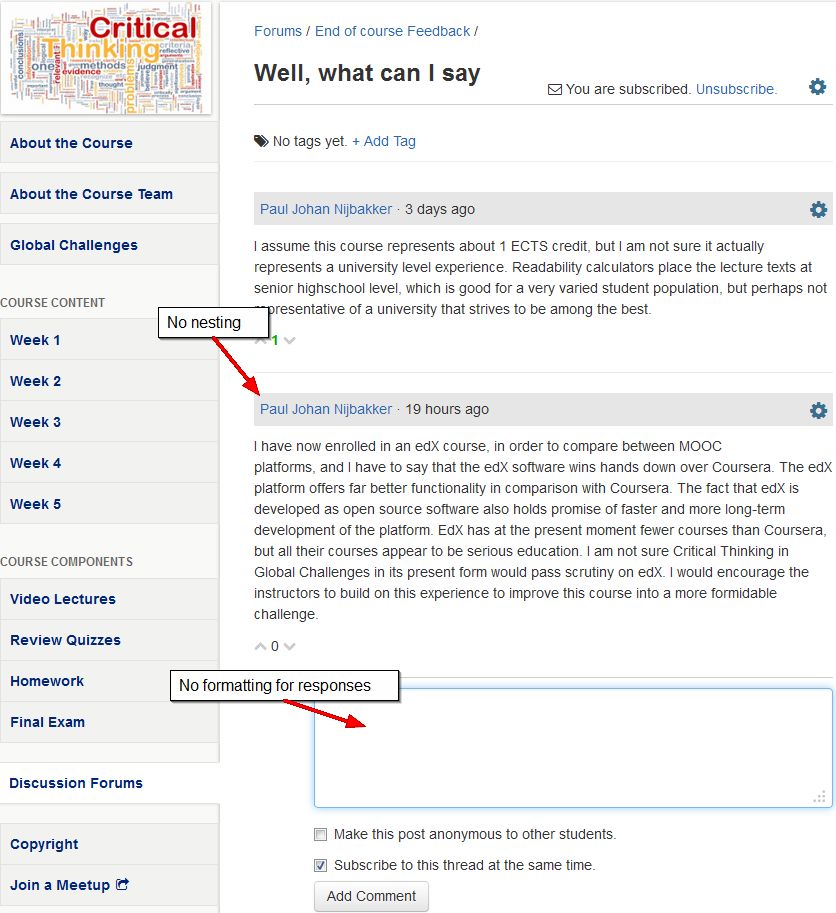
It has to be said, though, that the Coursera platform does leave a lot to be desired. It is reminiscent of Discendum Optima, only worse. The (open source, not-for-profit) MOOC platform edX, operated by MIT and Harvard University and their associates, is in comparison far more user-friendly and rich in functionality, especially in the tracking tools that appear to be totally lacking at user level in Coursera. This means it is very hard for students in a Coursera course to keep track of where they are in a course, what they have done and what remains to be done. The discussion forums in particular are nightmarish with very limited formatting, practically non-existent nesting and to all appearances no management tools that would have allowed a moderator to create some semblance of order in the organic mess of messages and threads.
The idea of MOOCs, making top-level university education available to the whole world for free, is admirable. If the challenges of managing a huge and very diverse student population and of evaluating and accrediting these students properly and realistically are met, MOOCs may well become a nail in the coffin of the traditional brick-and-mortar universities. It would be worthwhile therefore for our university of applied sciences to evaluate its options. We have some good teachers and some good courses and a lot of experience organising effective online education including accreditation. Even if a full-blown MOOC may be beyond our capability at the moment, the possibility of setting up large scale on-line courses whether or not with open registration and whether or not with fee-based enrolment, is something we should explore…
2 replies on “My MOOC Experience”
I read about Irma Mänty´s blog about the same course but obviously the students don´t learn to know their peers, or do they. What is the role of MOOCs for us “laymen”? Is it one way of being able to have huge numbers of students studying online? What I have read about the MOOC is that the information flow is huge and it is really difficult to keep up with all the postings.
It is very difficult to get to know anyone in particular in such a mas of users or to keep track of the messages. Coursera is particularly bad in that respect due to the way the forums are organised, edX is better. What certain users did was to form smaller study groups in Google+ or Facebook, based on shared background or interest I presume, but I did not join any.
MOOCs are announced as a new battleground in which universities will compete. Flagship MOOCs are taught by the most renowned professors in the field, they are like display cases. I do not think MOOCs will necessarily remain entirely free. The backers will want to generate revenue from it in one way or another.