Category: Teema-artikkeli

Featuring photo.

Artificial Intelligence for Sustainability Transition: Opportunities, Barriers, and Managerial Implications

Sustainability is no longer just a compliance issue or a corporate responsibility initiative. Recently, artificial intelligence (AI) has emerged as an increasingly crucial tool to enable sustainable development.

This article examines how AI can help companies create sustainability value and address environmental, social, and economic challenges.
Featuring photo.

Resilience through Regenerative Business: Business Model Canvas Development

The concept of regenerative business is receiving increasing attention as organizations seek ways to contribute positively to social-ecological systems while maintaining economic viability. However, the practical implementation of regenerative business remains challenging, and managers often lack simple tools for integrating regenerative thinking into business development.

This article presents the development of a Business Model Canvas for Regenerative Business, created within a Master’s-level regenerative business course at Lapland University of Applied Sciences.

Featuring photo.

Beyond the Green Light: Turning Sustainability Reporting into Transformative Learning

Many companies are struggling with the question, how can sustainability reporting assist in decision making process and continuous learning. This development-oriented case article explores what systematically repeated assessments and written explanations reveal about sustainability work — and how that knowledge could be utilized as a support of organizational renewal. The case study highlights the difficulty of understanding what lies behind the sustainability reporting: how the reporting affects the RDI project itself within time, what is to be learned, and how the results could affect future projects.

Featuring photo.

Resilience of a Detached House Heating System Against Prolonged Power Outages: A Computational Case Study

Modern societies have become very dependent on access to large amounts of energy, which highlights the importance of energy system resilience. Heating system resilience in residential buildings is especially important in the Arctic and cold-climate areas, where harsh environmental conditions and high heating demands increase vulnerability to energy supply disruptions.

This paper examines a wintertime power outage scenario for a detached house and presents a simplified computational approach for simulation studies

Featuring image.

Developing Digital Platform Competencies for Resilient Arctic Energy Communities: A Thematic Analysis of Student Learning Outcomes

This study explores students’ learning experiences in a Digital Platform course tailored for energy communities through a qualitative thematic analysis of reflective narratives. The findings reveal a significant transformation in students’ understanding of digital platforms, from perceiving them as basic technological tools to recognizing them as complex socio-technical ecosystems that facilitate value creation, stakeholder collaboration, and sustainable energy management.

Building Resilience Together in Tourism and Hospitality

Business resilience is built not only on a company’s own resources, but also on its relationships with other actors in the region.

The cases presented in this article demonstrate that resilience in tourism and hospitality is not simply the ability to withstand disruptions or return to previous ways of operating. Rather, resilience emerges from the capacity of businesses, employees, and regional actors to learn, share and apply knowledge, build relationships, and actively shape change.

Featuring photo.

The Ramp is there – but does the Service work? Accessibility opened a Window into Tourism Businesses’ Preparedness

The business has a ramp. But can a customer use it independently? If using the service requires assistance from an employee, is that assistance available when it is needed? Describing a service as accessible does not yet establish whether a customer can use it in practice. This depends on how premises, technology, staff and agreed procedures work together.

This article reflects on the Matrix 2 development work from the perspective of its implementers, drawing on project reporting and the authors’ experience. It does not assess the effectiveness of the activities.

Featuring photo.

Realigning Resilience in the Arctic Bioeconomy through Regenerative Capacity

Lapland UAS’ Research Programme on Regenerative Business aims to move beyond sustainability toward regeneration while acknowledging the ecological limits of restoration. From a theoretical perspective, we seek to better understand the interacting components that constitute the regenerative capacity of systems. In practice, the key question is how businesses, municipalities, and local communities can strengthen these capacities and translate them into regenerative practices that support viable livelihoods and ecological renewal.

Featuring photo.

Regenerative Higher Education: Changing the Way of Knowing, Being and Doing

Regenerative education can be understood as an emergent paradigm in higher education that moves beyond the instrumental and often technocratic orientations of sustainability education towards a relational, transformative and life-affirming approach.

This article focuses on regenerative higher education as a solution to move beyond traditional sustainability education.

Featuring photo.

Building Resilience through Immersive XR: a Game Development Perspective on Healthcare Education

XRHealthEdu project combines Extended Reality (XR) and Artificial Intelligence (AI) to create immersive learning experiences for healthcare education.

The goal is not to replace experience, but to help future professionals be more prepared when those experiences finally arrive. Ultimately, the value of XR and AI doesn´t lie in the technologies themselves, but in their ability to support the development of the players.

Featuring photo.

The Alpine Mindset in Arctic Outdoor Tourism

In this article, we will explore these neuropsychological skills- specifically robustness and resilience. In addition, we will explore how we can use these skills in the training of arctic guides.

Combining lessons from alpine environments with the needs of arctic traveling, it would be possible to add client and guides safety and create more value and benefit in the competition for the whole arctic tourism business.

Featuring photo.

Recognizing Moments of Resonance in Student Counselling

In a rapidly changing world, students need resources that help them face uncertainty about the future, explore different possibilities, and trust in their ability to navigate educational and career transitions.

The concept of resonance means simply to feel connected to the world.

Featuring photo.

Resilience of Teachers at Universities of Applied Sciences

Resilience means an individual’s ability to cope mentally as well as flexibility and capability to adapt and reorient in difficult or changing life situations.

Teaching is a meaningful profession that requires special competence in a subject. In addition, it requires the ability to deal with stress, changes and challenging interactive situations. Resilience supports the teacher’s ability to adapt to these challenges and develop professionally. This does not mean coping alone.

Kirjoittajan tiedot ja kuvituskuva.

Enemmän kuin majoitustoimintaa: Uudistava majoitusyritys ympäröivän paikan ja yhteisön keskuksena

Uudistavassa eli regeneratiivisessa majoitustoiminnassa majoitusyritys uudistaa sitä ympäröivää luontoa ja yhteisöä eli sen toiminnan vaikutukset ovat nettopositiivisia. Majoitusyritys ei siis ole vastuussa pelkästään omasta elinvoimaisuudestaan, vaan kannattava liiketoiminta käsitetään työkaluksi, jonka avulla majoitusyritys tuottaa kokonaisvaltaista arvoa paikalle, jossa se sijaitsee.

Kirjoittajien tiedot.

Yhteiskunnalliset yritykset innovoivat kestäviä ja tarvelähtöisiä palveluja Lappiin

Yhteiskunnalliset yritykset edustavat uutta ajattelutapaa. Sen sijaan, että ne edistäisivät talouskasvua hinnalla millä hyvänsä, ne integroivat talouden ihmisten, yhteiskuntaan ja luonnon hyvinvointiin.

Suomessa arvioidaan olevan noin 5 000 yhteiskunnallista yritystä, jotka työllistävät yli 85 000 henkilöä. Lapissa niitä on 148.

Kirjoittajan tiedot ja kuvituskuva.

Kohti palvelujen uutta versiota: tuotteistaminen ja palvelumuotoilu elämyspalvelujen kehittämisessä

Palvelujen kehitys suuntautuu kohti kokonaisvaltaisempia, ennakoivampia ja vastuullisempia ratkaisuja. Asiakaskokemus, merkityksellisyys ja kestävyys nousevat keskeisiksi kilpailutekijöiksi.

Tuotteistamisen opintojaksolla liiketalouden opiskelijat eivät vain harjoitelleet tuotteistamista, vaan kehittivät palveluja kahden yrityksen aitoihin tarpeisiin.

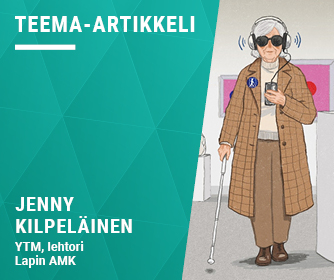
Kirjoittajan tiedot ja piiroskuva iäkkäästä sokeasta henkilöstä museossa.

On aika puhua esteettömyydestä – kohti yhdenvertaisempia matkailupalveluita Lapissa

Esteettömyys ei liity vain fyysisiin tiloihin, vaan on osa koko matkaketjua vaatien kokonaisvaltaista palvelumuotoilua ja monialaista osaamista. Matkailussa esteettömyys määritellään usein kolmen ulottuvuuden kautta: fyysinen, viestinnällinen ja sosiaalinen esteettömyys.

Tämä artikkeli pohjautuu Lapin ammattikorkeakoulussa tehtyyn selvitykseen Lapin esteettömän matkailun nykytilasta.

Kirjoittajien tiedot ja kuvituskuva.

Työkykyä tukeva uraohjaus julman optimismin aikana   

Uraohjaus on perinteisesti tukenut yksilöä kohti työelämässä menestymisen ihannekuvia. Vaikka vahvuusperustainen ajattelu on tuonut ohjaukseen myönteisiä elementtejä, se voi samalla huomaamatta vahvistaa käsitystä, että menestyminen on yksilön jatkuvan kehittämisen ja sopeutumisen varassa. Tässä piilee julman optimismin vaara. Yksilö pyrkii sinnikkäästi kohti ihanteita ja menestystä, jotka eivät ole realistisia. Julma optimismi ohjaa ylisuoriutumiseen.

Kirjoittajien tiedot ja kuvituskuva.

Digitaaliset palvelut 2.0 opiskelijan polulla – sujuvaa asiointia, oikea-aikaista ohjausta ja yhteentoimivia ratkaisuja

Korkeakoulun digitaalinen palveluympäristö on laajentunut vaiheittain, jopa hieman huomaamatta taustalla.  Vuosien aikana käyttöön on tullut uusia järjestelmiä hakemiseen, opiskelun aloittamiseen, oppimiseen ja opettamiseen, viestintään, ohjaukseen, harjoitteluun, valmistumiseen ja alumnivaiheeseen. Samanaikaisesti nämä kytkeytyvät entistä tiiviimmin sekä toisiinsa että kansalliseen koulutuksen digitaaliseen ekosysteemiin. Tarkastelemme tätä kokonaisuutta oppijan ja korkeakoulun näkökulmasta.

Kirjoittajan tiedot ja kuvituskuva.

Palveluiden murros lastensuojelussa  

Palveluiden murros näkyy lastensuojelussa kokonaisvaltaisena muutoksena, joka ulottuu rakenteisiin, toimintakulttuuriin ja työn arkeen. Keskeistä on siirtymä korjaavasta työstä ennaltaehkäisevään tukeen.

Lastensuojelun haasteina ovat palvelujärjestelmän monimutkaisuus, pirstaleisuus sekä resurssiniukkuus.