Ville Polvela, B. Eng., Specialist, Information and Communication Technology, Lapland University of Applied Sciences
Machine Learning and Data Engineering students Kalle Jyvälä, Nihar Buha, Ada Nardi, and Markus Sillanpää

Keywords: artificial intelligence, data, tourism
Introduction
Tourism is an important source of income and employment in Lapland. At the same time, rapid technological development is reshaping how tourism business operate, market their services, and engage with customers. Artificial intelligence (AI) has emerged as one of the most significant technological developments in the tourism sector, offering new opportunities for automation, personalisation, and data driven-decision-maketing (Bulchand-Gidumal et al., 2024). AI can also support the analysis of large and complex datasets, enabling tourism organisations to identify patterns, understand customer behaviour, and generate insights for business development (Samara et al., 2020). The aim of the Artificial Intelligence to Support Tourism Sales and Marketing Processes (AImama) project is to provide local companies in the travel and tourism sector with tools and solutions that help them utilise AI more effectively. By leveraging the existing data, companies can support business development and automate aspects of their daily operations. When used effectively, data can reveal previously unrecognised insights and opportunities.
This article presents two practical cases in which AI-based methods were used to analyse tourism-related datasets provided by partner companies.
Students of the Machine Learning and Data Engineering degree programme at Lapland University of Applied Sciences participated in extended research activities as part of their internship at FrostBit Software Lab during the summer of 2026. The partner companies provided the interns with authentic company data. Throughout the internship period, the students’ progress was monitored and guided in collaboration with Lapland UAS project specialists and representatives of the partner companies. The internship was supervised by Mikko Pajula, Ville Polvela and Sajjad Rahat.
The internship’s project work was only partly affiliated with the AImama project. The idea and the vision associated with the project aligned with the research goals of the internship. This brought together Lapland UAS interns and local Rovaniemi companies to drive advancements for future business practices. During the internship, all findings were compiled into this article providing real-world examples of AI analysis methods applied to tourism data. The insights from this report may benefit the AImama project and other interested parties.
Using AI for data analysis
The internship project involved local companies in Rovaniemi that operate in the tourism industry. For research purposes, the companies provided access to their private data, which was sensitive in nature and therefore had to be handled discreetly. The core idea was to uncover insights through AI-empowered analysis of data that the partner companies were already collecting.
The partner companies were contacted by the AImama project specialists before the start of the internship, but acquiring the data safely proved to be a challenge. How does one ensure that the company’s data, which is of course sensitive business data, is not left vulnerable or get stolen on the way? There are many potential solutions to this problem, but just as someone could have stolen a courier’s letters before the era of electronic communication, someone could hack into commonly used platforms to intercept data shared between parties. The solutions agreed upon by the interns and the companies were simple but effective for a small-scale project such as this.
The nature of the data provided by the two partner companies, Seven-1 and Bearhill Husky, varied from broad to narrow. For the purposes of this article, the terms “broad” and “narrow” are defined somewhat differently from their standard industry usage. “Broad” refers to data that contains a large number of data points and provides greater detail. It is objectively better for AI analysis, assuming, of course the data is of high quality, because it can always be trimmed down if necessary. “Narrow” data makes analysis difficult or simply impossible, due to its brevity and lack of data points. AI is no miracle worker but rather a tool, that requires the right conditions to be useful. Just as screwdrivers are useful for screws, and hammers are for nails, the two cannot be used interchangeably. AI is useful when a sufficient amount of quality data is available. To put it simply, the form and substance of the data do not matter. What is important is that it contains relevant metrics and that there is enough of it.
Case 1: Seven-1
In the first case, the company’s data consisted of text written by potential customers in over thirty-five languages. The text submitted by customers may always contain personal or sensitive information. Therefore, the dataset was considered sensitive and had to be handled securely. The data was simply uploaded to Google Drive by the partner company, and a download link was sent to the project supervisors and interns via email. Free-form text written by humans is difficult to analyse, since it does not adhere to a standard structure. The data was collected from users and potential customers who visited the travel company’s website and was written in multiple different languages. The best way to gain insights from this type of data is through natural language processing (NLP), a field of artificial intelligence that enables computers to understand, interpret and generate human language.
A rough overview of the pipeline:
- Process the raw data and make it readable for the subsequent steps.
- Extract the relevant text data.
- Make a large language model do various analyses to it through a lens of questions.
- Generate the final analysis.
All analyses were run locally using open-source large language models (LLMs) via Ollama – no data was sent to any cloud service for processing, which was important given the sensitivity of customer conversation data. The models used were gemma3:4b for fast classification, and gemma4:31b for the main analysis.
The data was labelled, which in this case means that each text entry was assigned a tag indicating its subject. During the labelling process, it was discovered that LLMs were able to catch six times as many cases of price-related questions than a more basic and quicker keyword search. LLMs can outperform keyword searches because they can take context into account, which leads to more matching cases.
Initially the project interns pursued an analysis method, using embedding and density-clustering. To unpack these terms a bit, embedding is a technique in machine learning that turns data like words, sentences, or pictures into long lists of numbers called vectors. These numbers capture the “meaning” of the data. Items in the data that mean similar things are placed close to each other in a giant mathematical space.
Clustering on the other hand, is a technique to partition a set of objects into groups. Objects within the same group (one cluster), are more similar to one another than to those in other groups. For instance, if one was to cluster musical instruments, certain criteria would yield different results: grouping them by genre (e.g., drums and electric guitars might cluster together because they are both staple metal band elements), or alternatively, clustering them by type (e.g., distinguishing a percussive instrument from a string one). The power of this methodology lies in its capacity to identify patterns and relationships within the data that would be imperceptible to human eyes alone. These methods can offer surprising and previously unknown insights into complex datasets.
Unfortunately, the data was not compatible with this approach. Two issues arose. The first was inherent overlap: the similarities between different entries were so extensive that no truly distinct clusters could be identified. Furthermore, the combination of language differences and the short length of the text entries proved problematic. Even when texts appeared semantically similar to a human reader, the mathematical representation failed to capture the true proximity.
The embedding approach was replaced with direct LLM analysis grouped by topic. This proved more effective for this data shape: the LLM used in the analysis natively understood more than languages represented in the dataset, eliminating the need for additional translation. Also, it handled short texts naturally and produced specific, nuanced findings that cluster labels would not have captured.
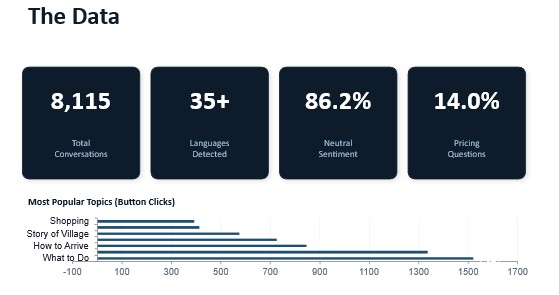
Figure 1. Seven-1 Chatbot Data Overview. Neutral sentiment dominated the dataset, pricing questions were prevalent and activities were the most popular topic.
In summary, the partner company’s data was analysed using large language models. Those models can understand the meaning of text written by humans better than other types of methods and process large volumes of text efficiently. The clearest discoveries from the data analysis were insights into tourists’ interests in cottage and igloo experiences near the Arctic Circle, Santa Claus experiences and price-related questions.
Case 2: Bearhill Husky
The second partner case involved a tourism company whose data consisted of Google reviews, Tripadvisor and Google Analytics data, as well as internal sales metrics. The dataset itself was narrow relative to typical AI analysis cases. While the data was workable for the company’s purposes and easy to analyse with contemporary methods, it was not optimal for the type of AI analysis approach the student interns were focused on researching. No company must bend their data collection to fit AI analysis purposes, but if that type of analysis is something they want to experiment with, it is a great idea to broaden the volume and types of data collected. Instead of continuing further with specific findings from the data, the more relevant aspect to the internship project’s purposes was the process and the methods used in secure data-handling, which could set a useful example for future projects.
Because the dataset contained sensitive information and other confidential data, all transmission and handling required rigorous security measures. While the chosen methods were experimental, they proved effective. The interns utilized selected services from CSC’s Sensitive Data (SD) suite to secure their data handling.
The Finnish IT Center for Science (CSC – Tieteen tietotekniikan keskus) provides IT support as well as modelling, computing and information services for academia, research institutes and companies in Finland. It operates under the administration of the Finnish Ministry of Education and Culture and follows a non-profit operating model. The two services used are as follows:
- SD Connect enables secure storage and sharing of sensitive research data. It automatically encrypts files during upload and decrypts them during download through an easy-to-use interface (CSC – IT Center for Science, n.d.).
- SD Desktop provides secure access over the public internet to the CSC ePouta virtual private cloud and allows users to securely analyse sensitive data remotely from their own computers via a web browser (CSC – IT Center for Science, n.d.).
Mikko Pajula, one of the internship supervisors, created a project in the CSC environment. After receiving the company’s data as an encrypted ZIP file, he uploaded it to SD Connect and created an SD Desktop workspace for secure data processing and analysis.
The interns logged in to the project through MyCSC service. They accessed the SD Desktop service using a web browser on their own computers and worked within a fully functional, isolated Ubuntu Linux environment. From the virtual desktop, the interns could open the encrypted ZIP file, analyse the data, and identify relevant insights. Once the analysis was completed, the intended next step was to export the results to SD Connect and subsequently to the interns’ own computers. However, the export functionality required root access, which was only available to Mikko Pajula.
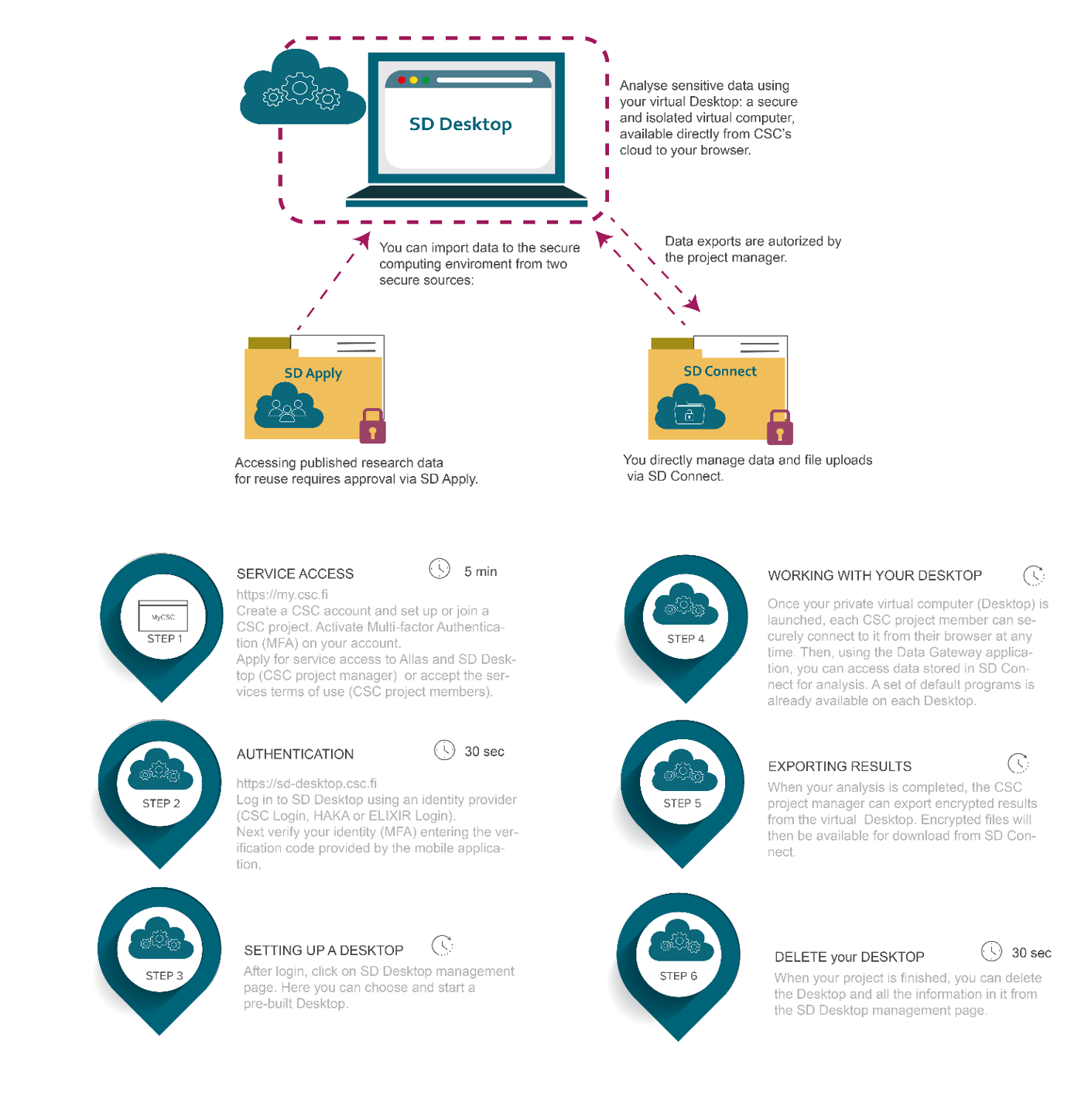
Figure 2. Overview of CSC’s Sensitive Data services and the SD Desktop workflow. Adapted from Analyze and compute with Sensitive Data Desktop, by CSC – IT Center for Science, n.d., (https://docs.csc.fi/data/sensitive-data/sd_desktop/).
In summary, the interns used tools available to academic research to handle and analyse the sensitive data safely. In so doing, they essentially performed a trial run for handling similarly sensitive data in future Lapland UAS projects.
This article was produced as part of the EU-co-funded project “Artificial Intelligence to Support Sales and Marketing Processes in Tourism.” The project aims to support tourism companies and operators in developing their expertise in artificial intelligence technology and utilizing it in marketing and sales processes in a responsible and sustainable manner.
References
Bulchand-Gidumal, J., Secin, E. W., O’Connor, P., & Buhalis, D. (2024). Artificial intelligence’s impact on hospitality and tourism marketing: exploring key themes and addressing challenges. Current Issues in Tourism, 27(14), 2345–2362. https://doi.org/10.1080/13683500.2023.2229480
CSC – IT Center for Science. (n.d.). Analyze and compute with Sensitive Data Desktop. https://docs.csc.fi/data/sensitive-data/sd_desktop/
CSC – IT Center for Science. (n.d.). SD Connect. https://research.csc.fi/service/sd-connect/
CSC – IT Center for Science. (n.d.). SD Desktop. https://research.csc.fi/service/sd-desktop/ Samara, D., Magnisalis, I., & Peristeras, V. (2020). Artificial intelligence and big data in tourism: A systematic literature review. Journal of Hospitality and Tourism Technology, 11(2), 343–367. https://doi.org/10.1108/JHTT-12-2018-0118