Jukka Luhas, D.Sc. (Tech.), Senior Researcher, Lapland University of Applied Sciences / Postdoctoral Researcher, University of Helsinki
Keywords: regenerative business; regeneration; transformations; transitions; complex systems
In the face of growing environmental and socio-political challenges, resilience has received increasing attention, particularly in the Arctic. The region is increasingly affected by climate change and pressures associated with mass tourism and resource extraction. To address these challenges and strengthen resilience, various actions have been suggested, such as sharing resources and having multiple jobs (Chapin et al. 2006). On the one hand, resilience provides ability “bounce forward” by combining stability and change, but on the other hand, it is seen as possibly problematic, as it can resist transformation and strengthen unsustainable system aspects (Scordato and Gulbrandsen 2024). More specifically, resilience in socio-economic systems, is closely linked to path dependence and lock-in. Maintaining interconnections, such as those between economies of scale and learning effects, can reinforce incumbent systems, whereas transformational interconnections can support lock-out and enable systemic renewal (Luhas 2022). Resilience enabling transformation, transformative resilience, integrated with regenerative operations are required, especially in the bioeconomy that is greatly dependent on ecological processes. Regenerative bioeconomy aims to move beyond circular economy, using transformative framework (Daniels et al. 2026). The European Economic and Social Committee (2026) stresses stakeholder involvement of all voices are not only heard but listened to and the importance of design for allowing nature to regenerate. By integrating transformative resilience and regenerative bioeconomy concepts in the Arctic, we propose that bioeconomy should not only recover from disturbances but use them as opportunities for ecological and socioeconomic renewal. We argue that this requires regenerative capacity.
Drawing a conceptual analogy from the field of genetics and molecular biology, regenerative capacity can be understood not simply as the ability to recover from disturbance, but as the ability to activate latent renewal mechanisms, mobilize appropriate resources, and reorganize the system toward functional restoration (Poss 2010). The capacity is dependent on internal and external factors, and decreases during the lifespan, however, exceptions exist (Yun 2015). In the Arctic bioeconomy context, regenerative capacity could refer to the collective ability to restore ecosystems, diversify livelihoods, redesign resource use, and create social-ecological conditions in which Arctic communities and ecosystems become more capable of renewal aftershocks, such as warm winter season or COVID-19.
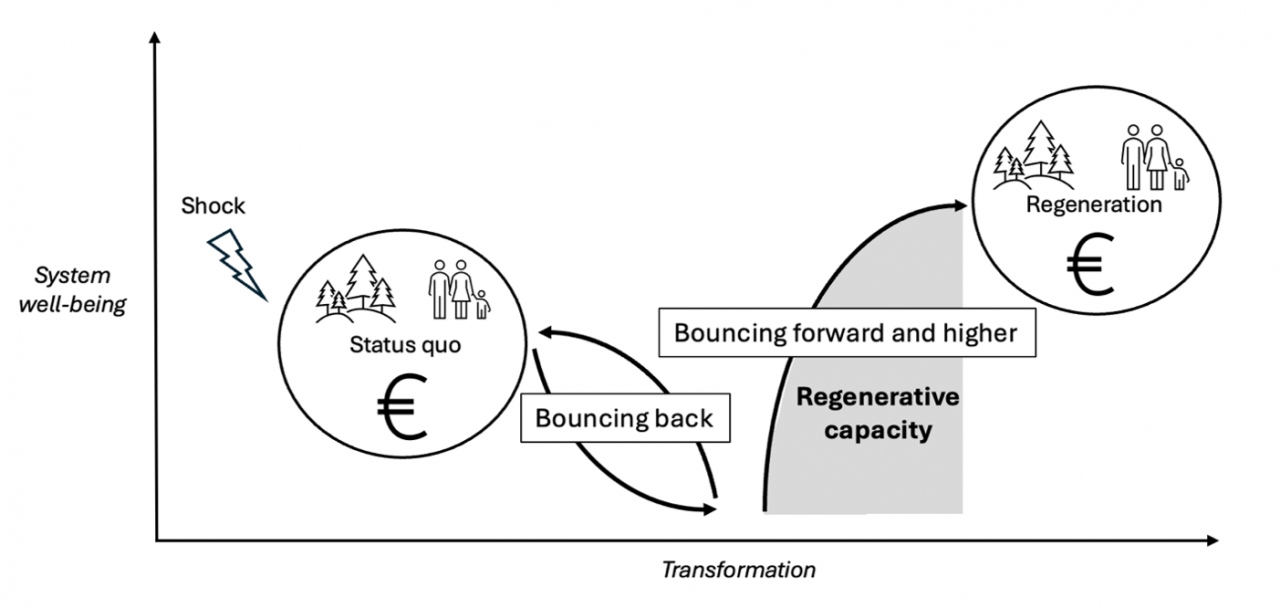
Figure 1: Instead of returning to the system’s status quo, transformative resilience enables the system to bounce forward and higher, which is dependent on the regenerative capacity.
Regenerative operations are already explored in the Arctic Bioeconomy, mainly in tourism sector, where regenerativity requires mindset shift from ego to eco and from competitive to collaborative, for example from the viewpoint of tour guides, this mean collaboration with nature-based tourism actors, such as accommodation and food service providers, for more resilient organizing (Omma 2024).Renfors and Kärp (2025) further emphasize that regenerative tourism products should not be developed merely from market potential, but from place-based ecological and social challenges. Their example of guided pink salmon fishing on the Teno River illustrates how a regenerative tourism product can turn the removal of an invasive species into a visitor experience that supports river restoration, nutrient balance, and local food provision. There is increasing need to include regenerative operations in other sectors, such as reindeer husbandry, wood, and nature product sector. For example, reindeer husbandry can strengthen Arctic regenerative capacity by helping to limit climate change driven increase in bushes (shrubification) and maintain open tundra landscapes (Verma et al. 2020). However, these benefits depend on carefully designed grazing regimes, particularly seasonal range rotation and the separation of summer and winter pastures, as winter-only grazing may partly constrain shrub expansion while causing less damage to lichen cover than summer or year-round grazing (Stark et al., 2026).
The concept of novel ecosystems adds another layer of complexity to resilience and regeneration. Novel ecosystems emerge as processes such as climate change, species introductions, and land-use transformation drive changes in ecosystem composition and functioning beyond historical conditions (Kerr et al., 2026). This raises questions about whose or what well-being should be prioritized and who determines the desired direction of transformation. For example, removing invasive pink salmon or reversing shrub expansion may prove difficult and could have unintended consequences for emerging ecosystems. Such ecosystems may also provide value for certain species and actors and support adaptation to climate change. Therefore, defining the boundaries of the system and the desired direction of transformation is essential, while recognizing that improvements for some species or stakeholders may come at the expense of others.
Looking ahead, our Research Programme on Regenerative Business aims to move beyond sustainability toward regeneration while acknowledging the ecological limits of restoration. From a theoretical perspective, we seek to better understand the interacting components that constitute the regenerative capacity of systems. In practice, the key question is how businesses, municipalities, and local communities can strengthen these capacities and translate them into regenerative practices that support viable livelihoods and ecological renewal.
References
Chapin, F.S., Hoel, M., Carpenter, S.R., Lubchenco, J., Walker, B., Callaghan, T.V., Folke, C., Levin, S.A., Mäler, K.G., Nilsson, C. and Barrett, S., 2006. Building resilience and adaptation to manage Arctic change. AMBIO: A Journal of the Human Environment, 35(4), pp.198- 202. https://doi.org/10.1579/0044-7447(2006)35[198:BRAATM]2.0.CO;2
Daniels, K., Bobbett, I., Cao, C., Tate, W.L. and Zhuang, J., 2026. Regenerative Agriculture Bioeconomy: A Concept Facilitating Agriculture Transition from Circular to Regenerative Systems. In Handbook of Circular Bioeconomy (pp. 93-109). Cham: Springer Nature Switzerland. https://doi.org/10.1007/978-3-032-07112-5_7
European Economic and Social Committee. 2026. EESC opinion: EU Bioeconomy strategy- Towards a circular, regenerative, and competitive bioeconomy. Available: https://www.eesc.europa.eu/en/our-work/opinions-information-reports/opinions/eu-bioeconomy-strategy-towards-circular-regenerative-and-competitive-bioeconomy (Cited 24 June 2026)
Kerr, M. R., Svenning, J. C., Riede, F., Buitenwerf, R., Abraham, A. J., Marjakangas, E. L., … & Ordonez, A. (2026). The making of novel ecosystems: A process‐based framework for measurement, analysis and application. Methods in Ecology and Evolution, 17(3), 683-704. https://doi.org/10.1111/2041-210x.70255
Luhas, J., 2022. The interconnections of lock-in mechanisms in the forest-based bioeconomy transition towards sustainability. Lappeenranta-Lahti University of Technology LUT. https://urn.fi/URN:ISBN:978-952-335-907-9
Omma, F.M., 2024. Regenerative nature-based tourism: Tour guides and stakeholder dynamics in Arctic Norway. Journal of Tourism Futures. https://doi.org/10.1108/JTF-10-2023-0237
Poss, K.D., 2010. Advances in understanding tissue regenerative capacity and mechanisms in animals. Nature Reviews Genetics, 11(10), pp.710-722. https://doi.org/10.1038/nrg2879
Renfors, S.M. and Kärp, M., 2025. Regenerative tourism products: Fulfilling the potential of places to flourish. https://doi.org/10.33351/mt.163395
Scordato, L. and Gulbrandsen, M., 2024. Resilience perspectives in sustainability transitions research: A systematic literature review. Environmental Innovation and Societal Transitions, 52, p.100887. 10.1016/j.eist.2024.100887
Stark, S., Wallén, H., Kurkilahti, M., Pekkarinen, A.J. and Kumpula, J., 2026. Plant interactions, climate, and the reindeer (Rangifer tarandus) interdependently shape vegetation in northern Finland. Ecological Applications, 36(2), p.e70200. https://doi.org/10.1002/eap.70200
Yun, M.H., 2015. Changes in regenerative capacity through lifespan. International journal of molecular sciences, 16(10), pp.25392-25432. 10.3390/ijms161025392