Sanna-Mari Renfors, PhD, Adjunct Professor, Principal Lecturer, Responsibility in Business and Services, Lapland University of Applied Sciences
Sanna-Maaria Siintoharju, MBA, Senior Lecturer, HAMK Design Factory, Häme University of Applied Sciences
Keywords: regenerative development, regenerative education, higher education, living systems thinking
Various global challenges such as climate change, geopolitical tensions, economic instability, and growing inequality have become interconnected, creating wide-reaching and highly destructive impacts (Lawrence et al., 2024). In this era of the so-called polycrisis, sustainable development is no longer considered adequate in terms of its goals and methods. Furthermore, sustainability education needs to engage more effectively with the complexity of these above-mentioned challenges. In higher education, it should provide future leaders and experts with skills to navigate and address polycrises as single-issue solutions are no longer sufficient (Beresford-Dey, 2025; van den Berg et al., 2022a).
Therefore, this article focuses on regenerative higher education as a solution to move beyond traditional sustainability education. Regenerative education refers to an approach that deepens learners’ understanding of the interconnectedness between human and natural systems and reinforces a shared responsibility for the well-being of the planet and society (Beresford-Hay, 2025). It is a co-evolutionary process among people involved and the larger systems and communities in which these are nested (Lopes Cardozo et al., 2025, p. 10). Regenerative education, as articulated across the cited literature, can be understood as an emergent paradigm in higher education that moves beyond the instrumental and often technocratic orientations of sustainability education towards a relational, transformative and life-affirming approach. Regenerative education is essential as contemporary crises require a fundamental paradigm shift in higher education, from mechanistic and reductionist frameworks towards holistic, integrative and ecological ways of knowing (Sterling, 2021).
Towards resilient living systems
Lopes Cardozo et al. (2025) describe regeneration as an approach rooted in living systems thinking, applied to the evolution of socio-ecological systems combined of people and nature. Consequently, regenerative development refers to a living system’s ability to continuously renew itself, promoting the well-being of both nature and humans and strengthening human agency in collaboration with nature (Gibbons, 2020). It is about helping ecological and social systems to grow stronger and thrive over time.
Regenerative development takes a dynamic, evolving approach in which humans and the living systems can grow together toward higher levels of resilience. As humans, we need to learn how to strengthen the resilience of the living systems, since these systems can sustain themselves only when they are resilient to change and disturbance (Gorissen et al., 2024). Resilience can therefore be understood as the ability of a system to preserve function and recover from disturbances (Buckton et al., 2023). In other words, it refers to a system’s capacity to navigate periods of disruption, absorb impacts, and recover without losing its core identity by learning how to respond, adjust, and develop in the face of change (du Plessis, 2012). It should be noted that in regenerative development, organisations do not focus solely on improving their own adaptability and capacity for change; they also contribute to strengthening the resilience of society as a whole (Hellström, 2023).
Lapland University of Applied Sciences provides master’s level education in regenerative business and leadership. Training master’s level students in regenerative development is essential because they are future leaders, experts, and decision-makers who will shape organisations and societies. They will lead systemic change within an organisation and apply the principles of regenerative development to the economy and business.
Higher education institutions as system participants
Furthermore, in regenerative development, higher education institutions are active participants of the socio-ecological system they are embedded in. To fully engage in this system, regenerative education involves rethinking organisational cultures, structures and purposes in higher education institutions. van den Berg et al. (2022b) identified key practices, drivers and barriers in the emergence of regenerative higher education, noting that while there is growing interest in regenerative approaches, these institutions often struggle with fixed systems, disciplinary silos and performance metrics that prioritise efficiency and output over relational and transformative learning outcomes. Nonetheless, drivers such as visionary leadership, transdisciplinary collaboration, and strong connections with external stakeholders can enable higher education institutions to transition towards more regenerative modes of operation.
Crucially, regenerative education reframes the ambition of higher education from “doing less harm” to actively contributing to the flourishing of all life. Armon (2021) conceptualises this shift as moving from sustainability to regeneration through deep collaboration, where higher education institutions act as hubs for collective learning and innovation that support systemic transformation. This involves cultivating ethical dispositions such as care and empathy, as well as fostering learners’ capacities to engage with complexity, uncertainty, and ambiguity.
Repurposing higher education
At its core, regenerative education adjusts the purpose of higher education from knowledge transmission and workforce preparation to the cultivation of regenerative capacities in learners, organisations and communities. A regenerative higher education institution aligns education with the potential of living systems (Lopes Cardozo et al., 2025). Its aim is to have a positive impact on the surrounding socio-ecological system and to create conditions that support the flourishing and renewal of all forms of life on Earth (Wessels & Grünwald, 2023). Within this reorientation, regenerative higher education foregrounds systems thinking, interconnectedness, and a commitment to enhancing the vitality of living systems rather than sustaining degraded ones.
A defining feature of regenerative higher education is its emphasis on relationality and co-creation. Lopes Cardozo (2023) highlights how regenerative pedagogies emerge through dialogical encounters and collaborative meaning-making between educators and learners. Learning becomes a shared, reflexive process in which participants engage with their own standpoints, values, and responsibilities in relation to social inequities and ecological degradation. Furthermore, as pedagogy is place-sourced, the local community plays a central role. Involving the community in higher education can help strengthen the vitality of local communities and bring a multi-perspective approach. Similarly, Wessels and Grünwald (2023) demonstrate how collective reflection and vulnerability can generate new forms of knowledge and practice that are grounded in lived experience.
Regenerative higher education also entails a shift in pedagogical practices towards experiential and embodied learning. It calls for an awareness of the Earth as a living system, along with support for transformative learning experiences that reconnect learners with the more-than-human world. Indeed, the one-way transmission of factual knowledge is not the central focus of regenerative higher education. Thus, two focal concepts in regenerative education are resourcing and imaging (cf. Lopes Cardozo et al., 2025). Resourcing is about supporting the learners’ inner potential to become capable of caring for system’s wellbeing and thriving. Imaging involves advancing regenerative efforts by strengthening the ability to perceive living beings and systems in action. (Lopes Cardozo et al., 2025.)
Final reflections
In synthesis, regenerative higher education (Figure 1) may be understood as a holistic, relational, and transformative approach to teaching and learning that seeks to restore and enhance the vitality of socio-ecological systems through place- and community-sourced, co-creative, experiential, and reflexive practices. It challenges dominant educational paradigms by integrating diverse knowledge systems, prioritising relationships and context, and aligning educational purposes with the flourishing of both human and more-than-human worlds.
Rather than a fixed model, regenerative higher education represents an evolving praxis that calls for institutional change. Such a perspective highlights the importance of systems thinking in higher education, as it reveals the interconnectedness between disciplines and between human and ecological systems. Teaching systems thinking is therefore foundational, as it enables learners to recognise the multiple relationships that shape everyday life – from households and communities to broader societal structures – and to understand how these systems can be transformed towards more regenerative way of life.
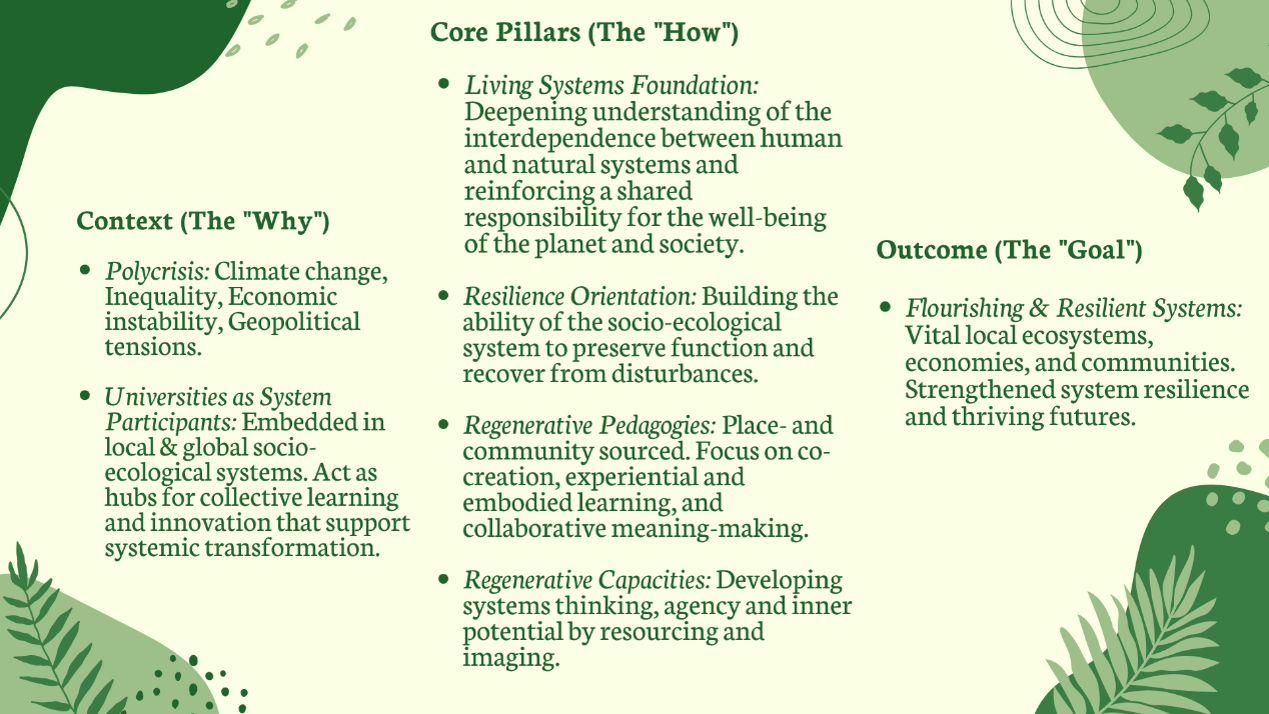
Figure 1. The main characteristics of regenerative higher education
Integrating regenerative higher education with resilience further strengthens this educational approach. It is not only about caring for the planet in abstract terms, but about fostering practical, place-sourced ways of living that enhance resilience of humans, communities, economies and ecosystems. Such practices demonstrate how regenerative higher education can cultivate awareness, responsibility, and adaptive capacity, positioning it as both a critical response to contemporary crises and a pathway toward more just, resilient, and thriving futures.
References
Armon, C. (2021). Collaboration in Higher Education: A Framework for Surpassing Sustainability and Attaining Regeneration. Philosophies, 6(4), 82. https://doi.org/10.3390/philosophies6040082
Beresford-Dey, M. (2025). Educational leadership: Enabling positive planetary action through regenerative practices and complexity leadership theory. Challenges, 16(3), 32. https://doi.org/10.3390/challe16030032
van den Berg, B., Poldner, K. A., Sjoer, E., & Wals, A. E. (2022a). ‘Sweet Acid’ An Interpretative Phenomenological Analysis of Students Navigating Regenerative Higher Education. Education Sciences, 12(8), 533. https://doi.org/10.3390/educsci12080533
van den Berg, B., Poldner, K., Sjoer, E., & Wals, A. (2022b). Practices, drivers and barriers of an emerging regenerative higher education in The Netherlands—A Podcast-Based Inquiry. Sustainability, 14(15), 9138. https://doi.org/10.3390/su14159138
Buckton, S. J., Fazey, I., Sharpe, B., Om, E. S., Doherty, B., Ball, P., … & Sinclair, M. (2023). The Regenerative Lens: A conceptual framework for regenerative social-ecological systems. One Earth, 6(7), 824-842. https://doi.org/10.1016/j.oneear.2023.06.006
Gibbons, L. V. (2020). Regenerative—The new sustainable? Sustainability, 12(13), 5483. https://doi.org/10.3390/su12135483
Gorissen, L., Bonaldi, K., Haerens, P. & Rato, L. (2024). Regenerative Development and Design: Its Origins, Essence, Practice and Potential as a Meta-Discipline to Elevate Governance, Innovation and Planetary Health. Retrieved from https://www.health.belgium.be/sites/default/files/media/files/2025-12/research_study_regenerative_development_and_design_updated_version_2025.pdf
Hellström, E. (2023). Kohti uusintavaa taloutta. Tavoitteena luonnon ja ihmisten elinvoima. Sitran selvityksiä, 235. https://www.sitra.fi/julkaisut/kohti-uusintavaa-taloutta/
Lawrence, M., Homer-Dixon, T., Janzwood, S., Rockström, J., Renn, O., & Donges, J. F. (2024). Global polycrisis: the causal mechanisms of crisis entanglement. Global Sustainability, 7,e6, 1–16. https://doi.org/10.1017/sus.2024.1
Lopes Cardozo, T. A. (2023). Walking the talk: Autoethnographic reflections on co-creating regenerative education within international development studies. Third World Quarterly, 44(7), 1625–1642. https://doi.org/10.1080/01436597.2023.2197206
Lopes Cardozo, M., van den Berg, B. & Wessels, K. (2025). The art of regenerative educatorship. A developmental guide. Routledge.
du Plessis, C. (2012). Towards a regenerative paradigm for the built environment. Building Research & Information, 40(1), 7–22. https://doi.org/10.1080/09613218.2012.628548
Sterling, S. (2021). Concern, Conception, and Consequence: Re-thinking the Paradigm of Higher Education in Dangerous Times. Frontiers in Sustainability, 2. https://doi.org/10.3389/frsus.2021.743806
Wessels, K. R., & Grünwald, L. (2023). Fulfilling the regenerative potential of higher education: collaborative autoethnography. Education Sciences, 13(10), 1037. https://doi.org/10.3390/educsci13101037