Tag: resilienssi

The author.

Perspectives on Building Resilience in the Arctic

While resilience is often understood as the capacity to adapt, recover, and thrive in the face of disturbances, the pace and scale of change in the Arctic demand more than recovery alone. They require proactive adaptation, learning, and transformation.

This Lumen issue starts with two columns from highly distinguished authors and goes on with professional articles and view point columns presenting the theme “Building Resilience in the Arctic”.
Pääkirjoitus suomeksi
Building Resilience in the Arctic

Finland’s geographic location in the North has made Finns build up preparedness even before the concept of resilience was created. Resilience is Finland’s stronghold, we are known for it, and visitors coming to Finland are eager to learn about our system. Today, current political uncertainty would require enhanced preparedness everywhere in Europe.

It is of utmost importance for resilience that remote Arctic areas remain inhabited. Locals are the first ones to notice unusual activity, suspicious looking strangers or unfamiliar technical equipment. Strong societal resilience serves against hybrid activities.
Kolumni suomeksi

The author.

Building Resilience for Whom in the Arctic?

For those who live in the North, the future is not merely a timeline in a strategy document. It is a question of whether people can continue to live here, work here, and pass on something they value to the next generation.

The Arctic becomes stronger when its people have both the resources and the genuine power to shape their own future. That is what resilience should ultimately be about.
Kolumni suomeksi

Featuring photo.

Resilience through Regenerative Business: Business Model Canvas Development

The concept of regenerative business is receiving increasing attention as organizations seek ways to contribute positively to social-ecological systems while maintaining economic viability. However, the practical implementation of regenerative business remains challenging, and managers often lack simple tools for integrating regenerative thinking into business development.

This article presents the development of a Business Model Canvas for Regenerative Business, created within a Master’s-level regenerative business course at Lapland University of Applied Sciences.

Featuring photo.

Beyond the Green Light: Turning Sustainability Reporting into Transformative Learning

Many companies are struggling with the question, how can sustainability reporting assist in decision making process and continuous learning. This development-oriented case article explores what systematically repeated assessments and written explanations reveal about sustainability work — and how that knowledge could be utilized as a support of organizational renewal. The case study highlights the difficulty of understanding what lies behind the sustainability reporting: how the reporting affects the RDI project itself within time, what is to be learned, and how the results could affect future projects.

Featuring photo.

Resilience of a Detached House Heating System Against Prolonged Power Outages: A Computational Case Study

Modern societies have become very dependent on access to large amounts of energy, which highlights the importance of energy system resilience. Heating system resilience in residential buildings is especially important in the Arctic and cold-climate areas, where harsh environmental conditions and high heating demands increase vulnerability to energy supply disruptions.

This paper examines a wintertime power outage scenario for a detached house and presents a simplified computational approach for simulation studies

Featuring image.

Developing Digital Platform Competencies for Resilient Arctic Energy Communities: A Thematic Analysis of Student Learning Outcomes

This study explores students’ learning experiences in a Digital Platform course tailored for energy communities through a qualitative thematic analysis of reflective narratives. The findings reveal a significant transformation in students’ understanding of digital platforms, from perceiving them as basic technological tools to recognizing them as complex socio-technical ecosystems that facilitate value creation, stakeholder collaboration, and sustainable energy management.

Building Resilience Together in Tourism and Hospitality

Business resilience is built not only on a company’s own resources, but also on its relationships with other actors in the region.

The cases presented in this article demonstrate that resilience in tourism and hospitality is not simply the ability to withstand disruptions or return to previous ways of operating. Rather, resilience emerges from the capacity of businesses, employees, and regional actors to learn, share and apply knowledge, build relationships, and actively shape change.

Featuring photo.

The Ramp is there – but does the Service work? Accessibility opened a Window into Tourism Businesses’ Preparedness

The business has a ramp. But can a customer use it independently? If using the service requires assistance from an employee, is that assistance available when it is needed? Describing a service as accessible does not yet establish whether a customer can use it in practice. This depends on how premises, technology, staff and agreed procedures work together.

This article reflects on the Matrix 2 development work from the perspective of its implementers, drawing on project reporting and the authors’ experience. It does not assess the effectiveness of the activities.

The author.

Building Arctic Resilience Through Food, Culture and Cooperation

In the Arctic context, resilience extends beyond infrastructure, economies and ecosystems. It is also deeply connected to people, communities, cultures and food systems.

Strengthening Arctic resilience through food systems requires support for sustainable use of local and Indigenous food resources, small-scale entrepreneurship, capable public authorities and long-term international cooperation.

Featuring photo.

Regenerative Higher Education: Changing the Way of Knowing, Being and Doing

Regenerative education can be understood as an emergent paradigm in higher education that moves beyond the instrumental and often technocratic orientations of sustainability education towards a relational, transformative and life-affirming approach.

This article focuses on regenerative higher education as a solution to move beyond traditional sustainability education.

Featuring photo.

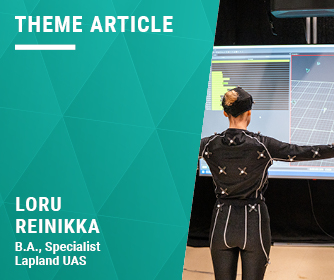
Building Resilience through Immersive XR: a Game Development Perspective on Healthcare Education

XRHealthEdu project combines Extended Reality (XR) and Artificial Intelligence (AI) to create immersive learning experiences for healthcare education.

The goal is not to replace experience, but to help future professionals be more prepared when those experiences finally arrive. Ultimately, the value of XR and AI doesn´t lie in the technologies themselves, but in their ability to support the development of the players.

Featuring photo.

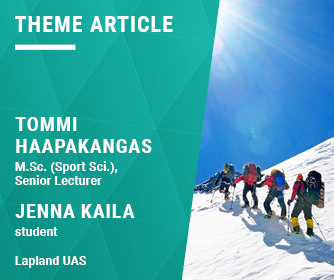
The Alpine Mindset in Arctic Outdoor Tourism

In this article, we will explore these neuropsychological skills- specifically robustness and resilience. In addition, we will explore how we can use these skills in the training of arctic guides.

Combining lessons from alpine environments with the needs of arctic traveling, it would be possible to add client and guides safety and create more value and benefit in the competition for the whole arctic tourism business.

Featuring photo.

Recognizing Moments of Resonance in Student Counselling

In a rapidly changing world, students need resources that help them face uncertainty about the future, explore different possibilities, and trust in their ability to navigate educational and career transitions.

The concept of resonance means simply to feel connected to the world.

Featuring photo.

Resilience of Teachers at Universities of Applied Sciences

Resilience means an individual’s ability to cope mentally as well as flexibility and capability to adapt and reorient in difficult or changing life situations.

Teaching is a meaningful profession that requires special competence in a subject. In addition, it requires the ability to deal with stress, changes and challenging interactive situations. Resilience supports the teacher’s ability to adapt to these challenges and develop professionally. This does not mean coping alone.