Anssi Tarkiainen, D.Sc.(Econ. & Bus.Adm.), Leading Researcher, Lapland University of Applied Sciences
Sanna-Mari Renfors, PhD, Adjunct Professor, Principal Lecturer, Responsibility in Business and Services, Lapland University of Applied Sciences
Markus Pellikka, MBA, Specialist, Responsibility in Business and Services, Lapland University of Applied Sciences
Abstract
The concept of regenerative business is receiving increasing attention as organizations seek ways to contribute positively to social-ecological systems while maintaining economic viability. However, the practical implementation of regenerative business remains challenging, and managers often lack simple tools for integrating regenerative thinking into business development. This article presents the development of a Business Model Canvas for Regenerative Business, created within a Master’s-level regenerative business course at Lapland University of Applied Sciences. Existing business model canvas extensions for circular, sustainable, social, and regenerative business were evaluated using two case companies and feedback from participating students. The Circular Business Model Canvas was selected as the foundation due to its clarity and usability, while selected regenerative elements from other canvases were incorporated into a revised design. The resulting canvas supports practitioners in identifying regenerative goals, defining value propositions for business, people, and nature, connecting regeneration to business activities and resources, and measuring regenerative outcomes. It offers a practical tool for developing regenerative business models.
Keywords: regenerative business, business model canvas, Arctic resilience, social-ecological systems, regenerative strategy, sustainable business models, business development, value creation
Introduction
According to Arctic Resilience Framework (ARAF), arctic resilience is “the capacity of people to learn, share and make use of their knowledge of social and ecological interactions and feedback, to deliberately and effectively engage in shaping adaptive or transformative social-ecological change” (ARAF 2016; Koivurova & Kähkönen 2018). For businesses operating in the Arctic, resilience-building may involve strengthening local communities, supporting sustainable livelihoods, regenerating ecosystems, creating circular resource flows, and enhancing the adaptive capacity of local social-ecological systems.
Socio-ecological change in the Arctic is occurring at an unprecedented pace. Climate warming in the region is significantly faster than the global average, resulting in declining sea ice, thawing permafrost, changes in biodiversity, shifting fish stocks, and increasing environmental uncertainty. These ecological transformations are closely interconnected with social, cultural, and economic systems, affecting the livelihoods, health, infrastructure, food security, and cultural practices of Arctic communities, particularly Indigenous Peoples who depend on local ecosystems for their well-being and identity. (https://arctic-council.org)
Resilience in business may refer to resilience of businesses (Bachtiar et al. 2023) or supply chains (Wei et al. 2026) or other issues focusing on resilience of business itself. However, businesses can also contribute to Arctic resilience on a broader scale. The definition of arctic resilience implies that it includes social and ecological interactions of people. The emerging concept of regenerative business appears to fit well with the idea of businesses participating in building arctic resilience. Hahn & Tampe (2021) define regenerative business as businesses that enhance, and thrive through, the health of socio-ecological systems in a co-evolutionary process. The challenge in the development of regenerative businesses is that regeneration itself is still ambiguous concept (Salonen et al. 2025). Salonen et al. (2025) raise open questions for advancing regenerative business, such as:
- What is being regenerated?
- What is the local place/context that serves as a basis for regenerative strategy/practices?
- Is regeneration a part of core business?
- Can regenerative strategies and practices align with business goals?
Salonen et al. (2025) call for both business leaders and academics to define what is meant by regenerative strategies. In this article, we report development of a business model canvas for regenerative business, which is intended to help business leaders to answer the above-mentioned questions. The development of the proposed business model canvas for regenerative business took place in the “Development of innovative business” -course, which is part of the core studies in the Master’s degree in Expert in Regenerative Business, in Lapland University of Applied Sciences’ Master School.
For companies, regenerative business becomes practically relevant when regenerative goals can be linked to customers, the value proposition, revenue logic, and organisational capabilities.
Regeneration in relation to local places and contexts
A key characteristic of regenerative business is its connection to a specific place and context. Unlike many sustainability approaches that focus on reducing negative impacts, regenerative business seeks to improve the health and vitality of local social-ecological systems. What regeneration means therefore depends on the local environment, culture, economy, and community.
For example, regeneration in an Arctic tourism company may involve strengthening local cultural heritage, supporting local suppliers, restoring degraded natural environments, or contributing to the vitality of local communities. In a food business, regeneration may involve improving the condition of fish stocks, reducing waste streams, and creating value from underutilized resources.
Because regeneration is context-specific, there is no single universal regenerative business model. Instead, businesses need practical tools for identifying what should be regenerated in their own operating environment and how business activities can contribute to that goal.
In regenerative business, place is a central concept (Fullerton, 2025; Hahn & Tampe, 2021). In traditional market logic, business operations are often viewed as detached from place, and place is understood as a geographical location. In regenerative business, the significance of place expands. It is seen as a unique, living, and multi-layered system that has taken shape through the interaction between people and nature over time (Mang & Reed, 2012). Businesses are seen as part of this socio-ecological system, and their goals are derived from the needs, opportunities, and limitations of the place. Consequently, the purpose, success, and value creation of a business are linked to the well-being and prosperity of the socio-ecological system the business is embedded in.
The changing role of place in business means that business planning and development are based on the specific needs and goals of that place: its ecological, historical, economic, social, and cultural context (Mang & Reed, 2012; Taveras-Dalmau et al., 2025). Since every place has evolved into something unique over time, business solutions cannot simply be transferred from one place to another as-is. There is no “one-size-fits-all” approach. Business development is place-based, meaning that business is always developed starting from the place itself and its unique characteristics, rather than using models imported from outside that are disconnected from the context. That is why it is important to understand what kinds of regenerative processes business can initiate and strengthen in the specific place.
Indeed, regenerative business requires the ability to understand a place. In order to plan and develop business, one must first understand the place as a whole—its unique dynamics, potential, and identity (Hahn & Tampe, 2025; Mang & Reed, 2012). This places a central emphasis on place-based knowledge that has been socially constructed within the local community and created over time through the place-related experiences of residents and communities. On a practical level, a regenerative approach requires that the voice of the place is heard by involving the local community in planning, development and decision-making to increase the wellbeing of the socio-ecological system.
Business models: From traditional to regenerative business
As a concept, business models started to emerge since the internet-boom of the mid-1990s, and over the years three different interpretations of the meaning of business models can be identified (Massa et al. 2017):
- business models as attributes of real firms
- business models as cognitive/linguistic schemas, and
- business models as formal conceptual representations of how a business functions.
Within the third interpretation, i.e. business models as formal conceptual representations, emerged the business model canvas (Massa et al. 2017), which was popularized by Osterwalder & Pigneur (2013). Osterwalder & Pigneur’s (2013) business model canvas has become popular among managers and practitioners. In this article we focus on the business models as formal conceptual representation of how a business functions, and especially business model canvasses.
Business model canvas
Osterwalder & Pigneur (2013) published their business model canvas, which is a planning tool where the user defines and describes nine different parts of the business model:
- Key partners
- Key activities
- Key resources
- Value proposition
- Customer relationships
- Channels
- Customer segments
- Cost structure
- Revenue structure
This business model canvas has become highly popular, as it is a simple and easy-to-use tool for planning and designing business models. In Google Scholar, it has received over 28.000 citations. A key benefit of the Business Model Canvas for companies is that it helps make key assumptions about the business model explicit and visible, allowing them to be discussed, tested and refined (Sibalija et al., 2021).
Extensions for including sustainability and regenerative thinking
The concept of business model has evolved, and newer definitions have been proposed. For regenerative business, Konietzko et al. (2023) define a regenerative business models as (p. 375):
“Organizations with regenerative business models focus on planetary health and societal wellbeing. They create and deliver value at multiple stakeholder levels—including nature, societies, customers, suppliers and partners, shareholders and investors, and employees—through activities promoting regenerative leadership, co-creative partnerships with nature, and justice and fairness. Capturing value through multi-capital accounting, they aim for a net positive impact across all stakeholder levels.”
In similar vein, there are different extensions for the business model canvas, for example for sustainable business models, circular business models and regenerative business models. Here we briefly present some alternative canvases.
Sarkar et al. (2023, p. 126) have published a Regenerative business model canvas, which augments Osterwalder & Pigneur’s (2013) business model canvas by introducing part that deals with community (sections on community partners, activities, resources, value proposition, beneficiary relationships and segments, deployment, mission cost and impact).
Bocken et al. (2018) have published a Circular business model canvas, which is useful also for regenerative business purposes (Sheikh, 2024). Circular business model canvas separates value proposition into value proposition for customers (profit), for people (common interest of society) and planet (positive impact for the environment).
Zero Waste Scotland presents a Sustainable Business Canvas, which adds negative and positive externalities into Osterwalder & Pigneur’s (2013) business model canvas. This tool has been designed by Loïc Bar and it is initially based on Business Model Canvas by Strategyzer.
Another example is Social/Regenerative business model canvas published by WWF Australia Innovate to Regenerate, The Australian Centre for Social Innovation, and Regen Studios. This canvas builds on Osterwalder & Pigneur’s (2013) business model canvas, and instructs to broaden value proposition and customer segments to include social and environmental beneficiaries. It also introduces a new component of reinvestment, which specifies returning value to business, community and natural systems.
Development of Business Model Canvas for Regenerative Business
As discussed in the previous section, there are already several options for business model canvases that can be used for creating ideas and developing business models for regenerative business. For managers, entrepreneurs, and practitioners, the task of creating regenerative business models may be challenging and different business model canvases might be confusing, especially if they need to think which of the alternative canvases they choose. Therefore, a refined business model canvas for regenerative business was set as a development target.
For practitioners, the usability of a business development tool is an important consideration. The tool should be sufficiently clear and intuitive to apply without requiring an extensive understanding of its underlying theoretical framework. Ultimately, its practical value depends on whether it can be consistently applied to support business development and value creation. Simplicity and ease of use have also been identified as strengths of the Business Model Canvas (Sibalija et al., 2021). This is particularly relevant when developing new regenerative Business Model Canvases, as practical usability should remain a key consideration.
Methods and Development Process
The development process is depicted in Figure 1. The students were first introduced the business model canvas and its four different business model canvas extensions (Sarkar et al., 2023; Bocken et al. 2018; Zero Waste Scotland; WWF Australia Innovate to Regenerate). They were also introduced two case firms, namely Arctic Land Adventure and Järki Särki, which both show characteristics of regenerative business.
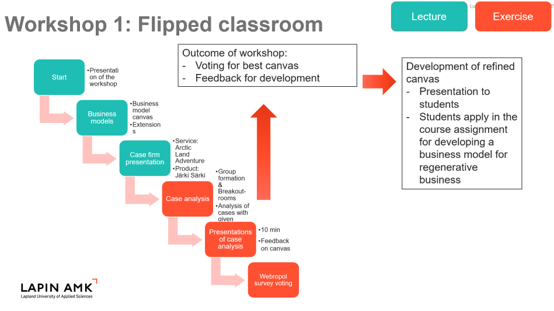
Figure 1. Development process during the course.
Students were then assigned to four different groups, and they were given one of the alternative business model canvas extensions and one of the case companies. They were instructed to analyze the case company’s business model using the given canvas, and to record their evaluation of the canvas and its usability, including feedback for developing the canvas further.
Finally, the student groups presented their assessment of the case company business model, using the filled canvas in their presentation. After the presentations, the students filled out an online survey (Webropol), where they voted for the best canvas and they were given the opportunity to give open feedback for developing the canvas.
Summary of the voting results and the feedback for the business model canvas is presented in Table 1. The Circular Business Model canvas (Bocken et al., 2018) received a clear majority of the students’ votes. However, the feedback indicated that the themes relating to regenerative business could be developed by introducing content of other canvases. The term “value capture” was perceived as confusing, although it is well established in the academic literature. During the discussion in the course, the term “revenue logic” received more support. In the feedback, the other canvases were perceived as less clear, but the important elements on regenerative themes were recognized in them.
Table1. Student voting result and summarized feedback on business model canvas extensions
| Sarkar et al. (2023) Regenerative business model canvas | Bocken et al. (2018) Circular business model canvas | Zero Waste Scotland. Sustainable Business Canvas | WWF Australia Innovate to Regenerate. Social/Regenerative Business model canvas | |
| % of votes (n=24) | 12 | 67 | 8 | 13 |
| Comments from group | Unclear, Does not have measurement of impact, Not clear if this about current or future business model. | Clear and easy-to-fill, Should differentiate between customer segments, The term “value capture” is confusing. | Unclear | Overlapping parts |
| Comments from webropol survey | Unclear, overlapping parts, lack of measures The perspective of regeneration is most clear in this canvas | Clear. Could be improved by introducing regeneration into it. Social impact and the role of community are limited. | Unclear and has a lot of boxes to fill. Also was perceived as clear. Could be combined to Sarkar et al. (2023)? | Growth and returning value to business, community and natural systems is an important part! Lacks measurement. What is being regenerated? Confusing and has overlapping parts. |
Based on voting results and feedback the Circular Business Model canvas (Bocken et al., 2018) was selected as a base for development and suggested regeneration themes were introduced into it. The resulting canvas was labelled as “Business Model Canvas for Regenerative Business”, which is presented in Appendix A.
How to use the Business Model Canvas for Regenerative Business
The Business Model Canvas for Regenerative Business can be used in different ways depending on the maturity of the business and the purpose of the development process. New regenerative business ideas may benefit from starting with regeneration goals, whereas existing businesses may find it easier to begin from their current business model and then explore opportunities for regeneration. It has been presented to entrepreneurs in an event organized by Arctic Wisdom project (Arktinen Viisaus, https://leadertunturilappi.fi/hankkeet/arktinen-viisaus/) and will be further disseminated in Lapland University of Applied Sciences’ Lapland Startup Hub (https://lapinamk.fi/uudessa-startup-hubissa-haudotaan-lappilaisten-ideoista-liiketoimintaa/).
Early-stage companies can embed locally relevant sustainability and regenerative goals in their business models from the outset. After completing the canvas, they can prioritise and test key assumptions with customers and stakeholders, making regeneration part of an iterative business development process (Shepherd & Gruber, 2021).
Approach 1: Starting from regeneration
When developing a regenerative business from the outset, the process can begin by defining the intended regenerative outcomes.
The first step is to identify what is being regenerated and why. This requires considering the local context and the social-ecological system in which the business operates. The focus may be, for example, on restoring ecosystem health, strengthening community wellbeing, revitalising local culture, improving resource cycles, or increasing the resilience of a local industry.
After defining the regeneration goals, the next step is to identify the mechanisms through which regeneration will occur. The business should clarify how its products, services, and activities contribute to the desired regenerative outcomes.
Once the regenerative logic has been defined, the business model can be developed around it. The value propositions for customers, communities, and nature are specified, followed by customer segments, customer relations, channels, revenue logic, key partners, activities, and resources. Finally, indicators are selected to monitor whether the desired regenerative outcomes are achieved and how value returns to the business, communities, and natural systems.
This approach helps ensure that regeneration is embedded in the core business model rather than added afterwards as a separate sustainability initiative.
Approach 2: Starting from the existing business model
For established organisations, it is often more practical to begin with the current business model.
The organisation first maps its existing value proposition, customer segments, customer relationships, channels, revenue logic, key activities, resources, partners, costs, and risks. This provides a shared understanding of how the business currently creates and captures value.
The next step is to examine the business from a regenerative perspective. Managers should ask what social, ecological, or community challenges are connected to their operations and where the organisation could contribute to regeneration. The canvas can then be used to identify what is being regenerated, how regeneration takes place, and how stakeholders, activities, and resources support regenerative outcomes.
Finally, suitable indicators are defined to monitor progress and evaluate how value is generated and returned to the business, communities, and natural systems.
This approach helps established organisations integrate regenerative thinking into existing operations while maintaining a viable business model.
Key questions when using the canvas
Regardless of the starting point, users of the canvas should consider the following questions:
- What is being regenerated?
- Why is regeneration needed in this specific context?
- How does the business contribute to regeneration?
- How is regeneration integrated into the core business model?
- Which stakeholders, activities, and resources enable regeneration?
- What costs and risks are involved?
- How is regeneration measured?
- How does value return to the business, communities, and natural systems?
The purpose of the canvas is not only to design profitable businesses, but also to help organisations understand how business activities can contribute to the long-term vitality and resilience of the social-ecological systems in which they operate.
References:
Bachtiar, N. K., Setiawan, A., Prastyan, G. A., & Kijkasiwat, P. (2023). Business resilience and growth strategy transformation post crisis. Journal of Innovation and Entrepreneurship, 12(1), 1-25. doi: https://doi.org/10.1186/s13731-023-00345-5
Bocken, N. M., Schuit, C. S., & Kraaijenhagen, C. (2018). Experimenting with a circular business model: Lessons from eight cases. Environmental innovation and societal transitions, 28, 79-95. doi: https://doi.org/10.1016/j.eist.2018.02.001
Fullerton, J. (2025). Regenerative economics. Revolutionary thinking for a world in crisis. New Society Publishers.
Hahn, T., & Tampe, M. (2021). Strategies for regenerative business. Strategic Organization, 19(3), 456-477. doi: https://doi.org/10.1177/1476127020979228
Konietzko, J., Das, A., & Bocken, N. (2023). Towards regenerative business models: A necessary shift?. Sustainable Production and Consumption, 38, 372-388. doi: https://doi.org/10.1016/j.spc.2023.04.014
Mang, P., & Reed, B. (2012). Designing from place: A regenerative framework and methodology. Building Research & Information, 40(1), 23–38. https://doi.org/10.1080/09613218.2012.621341
Massa, L., Tucci, C. L., & Afuah, A. (2017). A critical assessment of business model research. Academy of Management annals, 11(1), 73-104. doi: https://doi.org/10.5465/annals.2014.0072
Osterwalder, A., & Pigneur, Y. (2013). Business model generation: a handbook for visionaries, game changers, and challengers. John Wiley & Sons.
Salonen, K., Ritala, P., & Bocken, N. (2025). Emerging regenerative business paradigm: Narrative review, synthesis, and research agenda. Journal of Circular Economy, 3(1), 1-28. doi: https://doi.org/10.55845/DOZQ3944
Sarkar, C., Kotler, P., & Foglia, E. (2023). Regeneration: The future of community in a Permacrisis World. Idea bite press.
Sibalija, J., Barrett, D., Subasri, M., Bitacola, L,. & Kim, R.B. (2021). Understanding value in healthcare setting: An application of the business model canvas. Methodological Innovations, 14(3). doi: https://doi.org/10.1177/20597991211050477
Sheikh, A.Y. (2024). Better business: Re-thinking business models for nature positive outcomes. Working paper. Cambridge institute for Sustainability Leadership. University of Campbridge. Retrieved from [21.5.2026]: https://www.cisl.cam.ac.uk/files/cisl_a_track_better_business.pdf
Shepherd, D.A., & Gruber, M. (2021) The Lean Startup Framework: Closing the Academic-Practitioner Divide. Entrepreneurship Theory and Practice, 45(5), 967-998. doi: https://doi.org/10.1177/1042258719899415
Taveras-Dalmau, V., Becken, S., & Westoby, R. (2025). From paradigm blindness to paradigm shift? An integrative review and critical analysis of the regenerative paradigm. Ambio, 1–20. https://doi.org/10.1007/s13280-025-02232-7
Wei, S., Jiang, J., Chen, J., & Wang, Q. (2026). Digital technology and supply chain resilience: A literature review and emerging themes. International Transactions in Operational Research, 33(4), 2167-2189. doi: https://doi.org/10.1111/itor.70119
WWF Australia Innovate to Regenerate, The Australian Centre for Social Innovation, and Regen Studios. Regenerative Business Model Canvas. Retrieved from [21.5.2026]: https://assets.wwf.org.au/image/upload/v1698709631/Playback_B10_Regenerative_Business_Model_Canvas.pdf
Zero Waste Scotland. Sustainable Business Model Canvas. Retrieved [21.5.2026] from: https://www.zerowastescotland.org.uk/resources/sustainable-business-model-canvas
| Appendix Business Model Canvas for Regenerative Business | |||
| Adapted and developed from Bocken et al. (2018), Osterwalder & Pigneur (2013), Sarkar et al. (2023), WWF Australia Innovate to Regenerate (2026), Zero Waste Scotland (2026), Metropolia (2026). | |||
| Value Creation | Value Proposition | Value Delivery | |
| Key Stakeholders: Who are our most important stakeholders? What role do they play in our value proposition? What resources do we receive from them? Which parts of the process are handled by them? What added value do they create for us? | Superior value that is offered to customers compared to competitors (Profit): What value, benefits, or advantages do we provide? What customer need do we meet, or what problem do we solve? | Customer Relationships: What kind of relationship does each customer segment expect from us? What are our current relationships with the different customer segments? How can we develop and improve our customer relationship management efforts? | |
| Key Activities: What key activities are required to deliver our value proposition? Which key activities are the most critical for our success? Which key activities must we perform ourselves, and which can be carried out through partners? | Value Proposition for the Community (People): What value do we create? What needs do we meet, or what problems do we solve? | Value Proposition for the Environment (Planet): What value do we create? What needs do we meet, or what problems do we solve? | Channels: How is the value proposition delivered to customers? Who controls the delivery channel? |
| Revenue logic How can the profitability of the operation be ensured? What is the relationship between costs and revenues? | |||
| Key resources and capabilities: What key resources do we need to deliver our value proposition? Which resources are the most critical? How should these resources be developed and strengthened? | Cost structure: What are our most significant costs and investments? Do our costs and cost structure differ from those of our competitors? | Revenue streams: What are our customers willing to pay for? What are they currently paying for? What are the sources of our revenue streams? | Customer segments: For whom do we create value through our products and services? How have I selected the customers for whom I create value? How have I segmented and profiled my customers? |
| Change from current to future business: Which elements of the canvas are already in use today, and which represent new development initiatives? | Regeneration logic What is being regenerated? How will it be regenerated? How are key stakeholders, key activities, and key resources linked to the regeneration process? | Follow-up and measurement: How can the achievement of regeneration be measured? | |
| Costs of regeneration and potential negative externalities to community/environment: What costs and risks are involved? | Impact of regeneration and potential positive externalities to community and environment: How does value grow and return to the business, the community, and nature? | ||
References:
Bocken, N. M., Schuit, C. S., & Kraaijenhagen, C. (2018). Experimenting with a circular business model: Lessons from eight cases. Environmental innovation and societal transitions, 28, 79-95.
Osterwalder, A., & Pigneur, Y. (2013). Business model generation: a handbook for visionaries, game changers, and challengers. John Wiley & Sons.
Sarkar, C., Kotler, P., & Foglia, E. (2023). Regeneration: The future of community in a Permacrisis World. Idea bite press.
WWF Australia Innovate to Regenerate, The Australian Centre for Social Innovation, and Regen Studios. Regenerative Business Model Canvas. Retrieved from [21.5.2026]: https://assets.wwf.org.au/image/upload/v1698709631/Playback_B10_Regenerative_Business_Model_Canvas.pdf
Zero Waste Scotland. Sustainable Business Model Canvas. Retrieved [21.5.2026] from: https://www.zerowastescotland.org.uk/resources/sustainable-business-model-canvas
Metropolia. Business Model Canvas eli liiketoimintamalli työkaluna. Pienyrittäjän työkalupakki – työkirja tuote- ja palvelukehitysprosessin avuksi. Retrieved from [5.6.2026]: https://www.metropolia.fi/sites/default/files/images/julkaisut/Pienyrittajan-tyokalupakki/pienyrittaejaen_tyoekalupakki_muita_tyoekaluja_kehittaemisen_avuksi_tyoepohja_1.pdf