Mirva Juntti, Ph.D., Sustainability Manager, Lapland University of Applied Sciences
Anssi Tarkiainen, D.Sc. (Econ. & Bus. Adm.), Leading Researcher, Lapland University of Applied Sciences
Jukka Luhas, D.Sc. (Tech.), Senior Researcher, Lapland University of Applied Sciences
Abstract
Many companies are struggling with the question, how can sustainability reporting assist in decision making process and continuous learning. This development-oriented case article explores that question at Lapland University of Applied Sciences in the Finnish Arctic. Drawing on RDI-project monitoring records and discussion and an interview with an experienced RDI team leader, we examine what the systematically repeated assessments and written explanations reveal about sustainability work — and how that knowledge could be utilized as a support of organizational renewal. The case study highlights the difficulty of understanding what lies behind the sustainability reporting: how the reporting affects the RDI project itself within time, what is to be learned, and how the results could affect future projects. The example illustrates how project knowledge can travel into these areas through collaboration, whilst its connection to reporting remains difficult to trace. As a result, we propose clearer reporting prompts and a review process that connects project observations to shared learning, documented decisions and feedback. These proposals offer a practical starting point for any organization seeking to turn recurring sustainability reporting into knowledge and action, thus their contribution to organizational renewal and longer-term resilience requires further evaluation.
Keywords: sustainability reporting; project monitoring; organizational learning; resilience; universities of applied sciences
Introduction
Lapland University of Applied Sciences (Lapland UAS) requires project managers to regularly assess the implementation of responsibility objectives and measures promoting sustainable development. Each assessment includes a required traffic light category and an optional written explanation. The accumulated records offer an opportunity to examine reported progress across projects. They also raise a practical question: how can this information help the organization identify what was learned, which results are worth carrying forward and what decisions or support are needed?
This article asks: What does current project sustainability monitoring reveal, and how could its information and use be developed to support organizational renewal and continuous learning? We examine patterns in repeated assessments, the content and limitations of written responses, and the connection between reporting and management decisions. Based on this examination, we propose a framework for connecting project observations to shared learning and action. An interview with an RDI team leader with extensive experience in sustainability work and project preparation and delivery provides a practitioner’s perspective on the framework’s practical relevance. Her account also illustrates how project knowledge can reach companies, teaching and further development.
Our longer-term interest is in how learning across successive projects could strengthen regional capacity and contribute to healthier social and ecological systems. Regenerative value creation provides a direction for this work (Camrass, 2023). The present article offers proposals for developing reporting and the organizational practices through which its information is used. Their contribution to renewal, regional resilience and regenerative outcomes will require testing and follow-up evidence of decisions, changes in practice and social or ecological outcomes.
Project sustainability reporting and organizational renewal
Research on sustainability indicators links their usefulness to decision-making, planning and performance management (Adams & Frost, 2008). More precisely, sustainability reporting and organizational change can reinforce each other, as reporting can provide a basis for planning change while organizational change, in turn, improves subsequent reporting (Lozano et al., 2016). This directs attention to the organizational arrangements surrounding a report: who interprets it, which decisions it informs and how its implications are followed up. In this article, organizational renewal means deliberate changes to competencies, routines, resource allocation or cooperation in response to knowledge and changing conditions. This is greatly dependent on organizational change capability, which emphasizes an organization’s ability to learn, adapt its competencies and implement changes in response to changing conditions (Supriharyanti & Sukoco, 2023).
Resilience and related regenerative value creation provides a reason to develop this capacity. Duchek (2020) conceptualizes organizational resilience through anticipation, coping and adaptation. Project reporting may contribute to anticipation by making emerging risks or knowledge gaps visible, and to adaptation by documenting lessons that inform subsequent action. Demonstrating such a contribution requires evidence of how the information is used. A favorable implementation assessment alone leaves this connection open. Regenerative value creation introduces a further question about the direction of change. Hahn and Tampe (2021) connect regenerative business strategies to the health of the social-ecological systems in which organizations operate. Applying this perspective to an RDI project requires a named community or ecological system, a starting condition and a plausible account of the project’s contribution. Stronger organizational capabilities can support such work. Evidence of capability development and evidence of improved social or ecological conditions remain distinct.
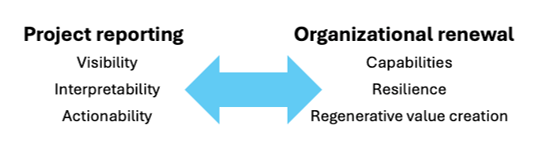
Figure 1: Operational framework linking sustainability project reporting to organizational renewal.
We use three practical qualities, visibility, interpretability, and actionability, to examine reporting (Figure 1). Visibility concerns whether relevant information is recorded consistently. Interpretability concerns whether the information explains what changed, why it matters and how confidently it can be assessed. Actionability concerns whether a person or decision-making body can use the information to choose and follow up an action. These qualities in relation to capabilities, related resilience and regenerative value creation form an analytical lens for the case and the proposed development criteria.
Case material and approach
The monitoring system and the analytical report
Lapland UAS has included sustainability in the procedure of the internal monitoring system since 2021. Project managers are asked to complete monitoring sheets twice a year. The question examined here has been: “How have the project’s responsibility objectives and measures promoting sustainable development been implemented?” Each response consists of a required traffic light assessment and an optional free-text explanation. Color red is understood to mean work that is pending or not yet started, yellow work in progress, and green work that is completed. These descriptions reflect the participants’ own understanding.
For this article, the entire dataset collected since 2021 was analyzed. The analyses cover responses to the sustainability implementation question and exclude records without a traffic light value. Project identifiers and timestamps are used to examine repeated assessments. The data includes 634 assessments from 271 projects, of which 160 have repeated observations. Projects with a single observation count toward the overall dataset but are left out of the first-to-last comparison. Table 1 summarizes the units of analysis.
Table 1. Dataset and comparison groups.
| Unit | Number | Use |
| Assessments | 634 | Recorded sustainability implementation assessments |
| Distinct projects | 271 | Projects represented in the filtered dataset |
| Projects with repeated assessments | 160 | First-to-last assessment comparison |
| Projects with one assessment | 111 | Included in the dataset; excluded from trajectories |
The present article reappraises the report’s aggregate tables and analytical descriptions. It does not independently reproduce the processing of the underlying project records. The discussion dates the monitoring practice to 2021. Exact extraction dates and response coverage are unspecified in the analytical report, and the number of projects represented provide no direct estimate of the response rate across all eligible projects.
Interpretation and evidence boundaries
The analysis separates three kinds of statement. Numerical observations are taken from the report’s tables and figures. Accounts of reporting practices are attributed to the development discussion. Proposed criteria and governance arrangements are recommendations derived from the identified information needs and the conceptual lens. The discussion examples support questions for further examination; their frequency across the dataset has not been established through systematic qualitative coding.
The report also contains an exploratory keyword analysis of open responses, grouping terms under integration, learning and collaboration. The discussion confirms that detailed qualitative analysis was still pending. Keyword occurrences are therefore treated as indications of reported topics. They require contextual examination before they can support claims about capability development. This approach keeps the assessment of the monitoring instrument open to both useful practices and limitations.
What the monitoring reveals
Repeated assessments show stable or upward endpoint trajectories
Of the 160 projects with repeated assessments, 108 (67.5%) retained the same traffic light category between their first and last recorded observation and 52 (32.5%) moved to a higher category. The largest group comprises 69 projects that remained green (43.1% of the repeated-observation group). A further 32 remained yellow (20.0%), and 31 moved from yellow to green (19.4%). Of the projects initially assessed as red, 15 moved to green, six moved to yellow and seven remained red. Figure 2 presents the complete comparison of the first and the last assessments of the projects.
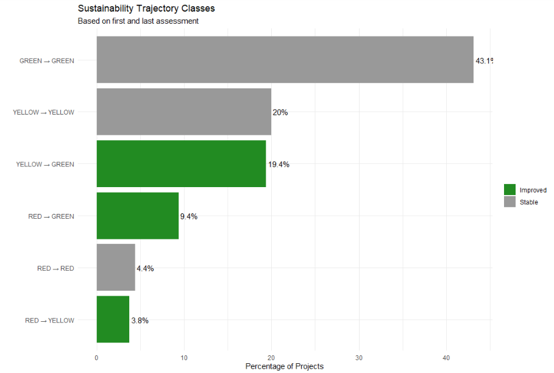
Figure 2. Sustainability Trajectory Classes
Narrative responses offer uneven explanations of change
The data included responses to questions about achievement of sustainability goals and practices. The responses provide interesting information of sustainability in the projects, which has potential for utilization for organizational development towards regenerative approaches. The current responses in the data are heterogenous. Table 2 describes the lenght distribution of the responses (responses with missing values omitted).
Table 2. Length distribution of the responses
| Lenght (words) | Count | % |
| 1–5 | 96 | 19.7 |
| 6–20 | 272 | 55.9 |
| 21–50 | 112 | 23.0 |
| 51–100 | 8 | 1.6 |
Also the response styles showed heterogeneity. Initial classification of the response styles is presented in Figure 3. The procedure for classification was the following:
- The responses and occurrences of terms were explored to identify different response styles
- Based on exploration, typical words for each response style were listed
- Responses were classified into different response styles, using the list of typical words
- Response style “Actions” describes actions during the project, such as sustainable travel choices
- Response style “SDG” refers to sustainable development goals in the text
- Response style “Impacts” describes the results or benefits achieved by the project
- Response style “Status” describes the status of the project, for example that project is still in the stage of beginning
The most common reporting style was describing sustainability-related actions (31%), followed by references to SDGs (22%). Explicit references to sustainability impacts appeared in approximately one fifth of responses (20%), while 14% of responses focused on reporting the status of the project. The categories overlap and these percentages should not be interpreted as mutually exclusive groups: A response may simultaneously mention SDGs, actions, and impacts.
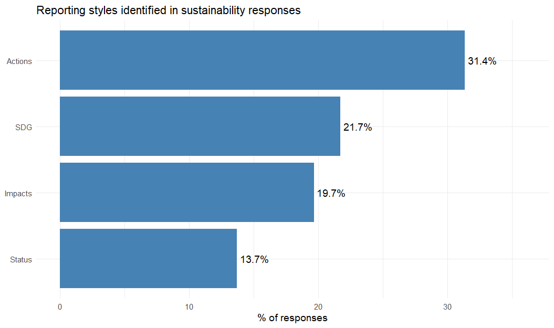
Figure 3. Initial text based classification of response styles.
The monitoring system provides space for project managers to explain their assessments. In the development discussion, the analyst described responses ranging from a single affirmative word to accounts of travel choices and education-related sustainability objectives. Other examples identified Sustainable Development Goals or referred to institutional principles. The discussion also described a project whose color changed from red to green while its accompanying explanation remained the same. These are selected examples reported by the analyst; their prevalence remains unquantified.
Such variation matters for interpretation. A reference to a sustainability objective identifies an orientation. An account of an implemented measure identifies activity. A description of what changed, for whom and on what evidence makes a stronger contribution to evaluating results. The current broad question and optional text field allow all of these forms, which limits consistent comparison of the reasons behind a color assessment.
The connection to decisions needs to become traceable
The interview of an experienced practitioner (conducted on 17 September 2026) validated the proposed connection between sustainability reporting, organizational learning and management decisions. The interviewee has extensive experience in sustainability work and in preparing and delivering RDI projects, including responsibility for reviewing a project portfolio as an RDI team leader. Her account supports a central proposition of the framework: monitoring becomes useful for organizational renewal once recorded observations are interpreted together and connected to subsequent action. The interviewee considers traffic light categories useful for identifying projects that may need attention. Nevertheless, the written sustainability assessments are discussed infrequently, and she could not identify how her own entries had informed decisions on a larger scale. This points out the development need in review and feedback practices, through which reported information becomes actionable.
The interviewee’s account of the project shows why learning and continuity should be made visible. As the project’s initiator, she described how cooperation with local companies led to a carbon footprint calculator for steel products, strengthened expertise within Lapland UAS, contributed to teaching and student projects, and informed a follow-on project. The example gives the framework practical substance: relevant project knowledge covers what was learned, where it was applied and how it shaped further development. A review process that captures these connections could help the organization to recognize results worth carrying forward. The account illustrates knowledge transfer, but whether the project’s monitoring entries contributed to it remains unverified.
The interview assisted in translating the framework into practical reporting requirements: the uncertainty about the expected level of details may limit written explanations, and the quite rough three-color traffic light category may hide the progress and learning between assessments. The interviewee’s suggestions, namely examples of useful written responses and discussion of selected assessments, support the need for clearer guidance and shared interpretation. Together, these observations offer preliminary, practice-based support for a review sequence that explains the assessment, identifies changes and learning, agrees on a response and feeds the decision back to the project manager. Testing this sequence across projects would show how far it contributes to organizational renewal.
Criteria for reporting to support renewal
To sum up, we propose eight questions to help to connect sustainability reporting to monitoring and reporting (Table 3). They would provide examples of useful written responses and discussion.
Table 3. Proposed criteria for project review and management use.
| Criterion | Information required | Management use |
| Intended change | The problem, the people or ecosystem affected, the starting point and the timeframe. | Agree on the priority and intended result. |
| Practices to reconsider | Rules, routines or assumptions that help or hinder progress. | Identify a practice or policy to revise. |
| Contribution and evidence | Actions taken, observed results, supporting evidence and other possible explanations. | Assess whether to continue, adjust or stop. |
| Benefits and trade-offs | Benefits, burdens, dependencies and possible effects elsewhere or later. | Address risks and competing objectives. |
| Participation | Whose knowledge informed the work and whose perspective remains missing. | Strengthening cooperation and participation. |
| Learning and capabilities | New knowledge or skills, changed routines and potential use in education or partnerships. | Share and apply the learning in future actions. |
| Continuity and ownership | Who will use the result after the project and what resources are required. | Agree on responsibility and implementation resources. |
| Follow-up and correction | Indicators, review date and observations that would prompt a different course. | Review outcomes and revise the decision. |
To ease the routine monitoring, the eight criteria could be further condensed into three guiding prompts: 1. what sustainability-related action was taken or what changed since the previous assessment; 2. what observation supports that account; 3. and what needs attention or should be carried into future work. A short example under each prompt could show the expected level of detail. The meanings of red, yellow and green should also be defined in relation to the project’s stage, so that a color describes progress in line with the agreed expectation. These changes would need to be tested with project managers before adoption.
Lapland UAS would also need an agreed process for responding to the reports. A designated reviewer could discuss selected entries with project managers and bring shared development needs to the relevant forum. Agreed actions would have a responsible person and a review date. Feedback would show project managers how their reports were used. Recording useful methods, contacts and results in a shared, searchable resource could help carry learning into teaching, partnerships and future projects – as well as companies and other stakeholders.
Discussion
The central development opportunity in this case study is to connect recurring sustainability assessments to shared learning and decisions. Lapland UAS already collects information that can reveal patterns across its RDI projects. Making this information useful for organizational renewal requires a process for explaining the assessments, discussing their implications and agreeing on action. This interpretation is consistent with the reciprocal relationship between sustainability reporting and organizational change described by Lozano et al. (2016), and with the integration of sustainability information into planning and management examined by Adams and Frost (2008).
The proposed framework brings this connection into practical focus through visibility, interpretability and actionability. Clear reporting questions help make relevant experiences visible. Evidence and an explanation of what changed help others interpret them. Agreed responsibilities, feedback and follow-up create a route from interpretation to action. The experienced interviewee’s account provides preliminary support for this framework: the interviewee recognized the value of traffic light monitoring while describing uncertainty about how written assessments influence decisions. The project example also illustrated the knowledge worth capturing — expertise that reaches companies, teaching and subsequent projects. A shared review process could help identify and support such connections across the portfolio.
It is evident that Lapland UAS’s RDI project reporting practices can strengthen the organization’s capacity to anticipate needs and adapt its work, which links the proposed approach to Duchek’s (2020) account of organizational resilience. For example, recurring support needs could inform project manager training, and useful methods and lessons could shape new project proposals. Assessing this contribution requires tracing reported observations through review, decision and implementation. The key question is whether the organization changes its practices in response to what projects have learned.
Regenerative value creation gives this renewal a longer-term direction. Project reviews could ask how the knowledge and practices developed contribute to the wellbeing of communities and ecosystems. In the UAS context, this means examining local capabilities, ecological dependencies and opportunities to participate, alongside the benefits and burdens of proposed changes. A workshop using backcasting from a shared 2050 vision could help identify the capabilities and decisions needed today. This would be a future development exercise whose contribution would require separate evaluations.
It is to be said that the project managers already carry a substantial reporting load. The approach should therefore be proportionate to the value of the information collected. Short, guided updates, reuse of existing project information and selected review discussions offer a practical starting point. A pilot should examine the time required, the usefulness of the information and the actions it informs. Feedback to project managers would clarify the purpose of reporting and improve later entries.
Conclusions
Lapland UAS project monitoring provides a recurring source of sustainability information. Among the 160 projects with repeated assessments, 32.5 % moved to a higher traffic light category between their first and last recorded assessments, and 67.5 % stayed in their initial category. Explaining these patterns as learning or changes in practice requires more detailed narrative evidence and a traceable account of how the information is used.
The proposed approach links project assessments to evidence, learning, continuity and a documented management response. The interview shows both the value of project results that spread into teaching and further development and the difficulty of tracing that learning through current monitoring. The next step is to pilot clearer reporting prompts, defined traffic light categories, selected review discussions and feedback to project managers. Follow-up should examine whether recorded observations inform identifiable decisions and future projects. Claims about longer-term social or ecological benefits will need evidence of those outcomes.
The findings of this case study provide a basis for developing and testing the framework. Self-reported assessments, uncertain response coverage and varying interpretations of the categories limit conclusions about project outcomes. The preliminary text analysis and the authors’ insider perspectives also need further examination. The single expert interview added depth and practical insight, but broader testing is needed to assess the framework’s usefulness across projects. The next step would be to pilot the new reporting questions and review process and trace whether it leads to more identifiable reporting, learning, decisions and changes in practice. Evidence of longer-term contributions to resilience and regenerative outcomes would also require further follow-up and investigation.
References
Adams, C. A., & Frost, G. R. (2008). Integrating sustainability reporting into management practices. Accounting Forum, 32(4), 288–302. https://doi.org/10.1016/j.accfor.2008.05.002
Camrass, K. (2023). Regenerative futures: eight principles for thinking and practice. Journal of Futures Studies, 28(1), 89-99. https://doi.org/10.6531/JFS.202309_28(1).0008
Duchek, S. (2020). Organizational resilience: A capability-based conceptualization. Business Research, 13(1), 215–246. https://doi.org/10.1007/s40685-019-0085-7
Hahn, T., & Tampe, M. (2021). Strategies for regenerative business. Strategic Organization, 19(3), 456–477. https://doi.org/10.1177/1476127020979228
Lozano, R., Nummert, B., & Ceulemans, K. (2016). Elucidating the relationship between sustainability reporting and organisational change management for sustainability. Journal of cleaner production, 125, 168-188. http://dx.doi.org/10.1016/j.jclepro.2016.03.021
Supriharyanti, E., & Sukoco, B. M. (2023). Organizational change capability: a systematic review and future research directions. Management Research Review, 46(1), 46-81. https://doi.org/10.1108/MRR-01-2021-0039