Reko Silvenius, MA, Specialist, Responsibility in Business and Services, Lapland University of Applied Sciences
Pasi Satokangas, M.Soc.Sc., Specialist, Responsibility in Business and Services, Lapland University of Applied Sciences
Keywords: resilience, risk management, preparedness, accessibility, tourism, foresight.
A tourism business’s resilience – its ability to maintain operations during disruptions, adapt and learn – often rests on assumptions that remain unchecked until something goes wrong. In a Matrix 2 project workshop, accessibility brought these assumptions to light. It also prompted discussion about the role of expertise, cooperation and local trust in preparedness and risk management.
The business has a ramp. But can a customer use it independently? If using the service requires assistance from an employee, is that assistance available when it is needed? Describing a service as accessible does not yet establish whether a customer can use it in practice. This depends on how premises, technology, staff and agreed procedures work together.
This article reflects on the Matrix 2 development work from the perspective of its implementers, drawing on project reporting and the authors’ experience. It does not assess the effectiveness of the activities.
At the Matrix 2 workshop in Sirkka, Kittilä, accessibility was examined as part of risk management in cooperation with the Equal and Accessible Lapland project (Yhdenvertainen ja esteetön Lappi). Accessibility specialist Tea Tuohioja from Estea illustrated the conditions that allow customers to act independently and safely. A portable ramp, a slippery floor, missing contrast markings on stairs and unclear signage made barriers to using services tangible. Injury or fatigue can also temporarily increase a person’s need for accessible services.
These observations raised a broader question: what does a business’s service assume about the capabilities of its customers, staff and partners? If a customer buys a service or travels to a destination based on accessibility information, the service must meet that description in practice. Checking accessibility in advance supports customer safety and helps prevent situations in which a service cannot be used as agreed. If the service does not match the accessibility information provided, the consequences may include customer disappointment, a safety risk, reputational damage or a claim for compensation.
Participants in Sirkka examined accessibility observations as business risks, assessed their consequences and planned actions and responsibilities. In this way, examining accessibility made risk management concrete: how can a business serve its intended customer groups safely and deliver on its promises?
What operations rely on
For the project team, accessibility provided a lens through which to examine preparedness more broadly. The connection is practical: for example, whether a lift can be used during a power outage depends on its power supply and backup arrangements. The same applies to a business’s overall operational capacity. Electricity and telecommunications are needed, staff must know how to act, and partners must be able to play their part. Whose capacity do our operations depend on?
Success can also reveal dependencies. Safety-II thinking complements the examination of shortcomings by asking what enables success under varying conditions (Hollnagel et al. 2013). An experienced employee’s judgement may help a business cope with a disruption while also revealing how much its operations depend on one person’s expertise. Learning from success may then mean sharing expertise and strengthening shared ways of working.
In this article, resilience means the ability to maintain operations during disruptions, adapt to change, learn and when necessary, revise ways of working. In Lapland’s tourism sector, this ability is supported by knowledge of local conditions and cooperation between businesses, authorities and other actors. However, changes in transport connections, workforce availability and winter conditions also raise new questions for experienced operators.
Preparedness therefore requires both identifying current dependencies and assessing future changes. Foresight helps businesses consider alternatives before an investment, a service promise or a partnership commits them to a particular way of operating.
Matrix 2 brought risks into a shared discussion
The Matrix 2 project, co-funded by the European Union through the European Regional Development Fund (ERDF), with funding granted by the Regional Council of Lapland, continued the development of strategic risk management for tourism businesses begun in the earlier Matrix project. Implemented in 2024–2026, it developed foresight and preparedness methods and a digital toolkit for businesses.
Twenty interviews conducted in autumn 2024 indicated that risk management in Lapland’s tourism businesses focused on operational activities and statutory obligations. Strategic issues were also discussed informally. Businesses wanted information about changes in their operating environment and support for examining and documenting risks systematically.
Future Risk Labs were the project’s five regional workshops, in which tourism businesses and specialists examined current challenges and approaches to preparedness. The themes were selected together with businesses and regional organizations. Topics included accessibility, social sustainability and crisis communication.
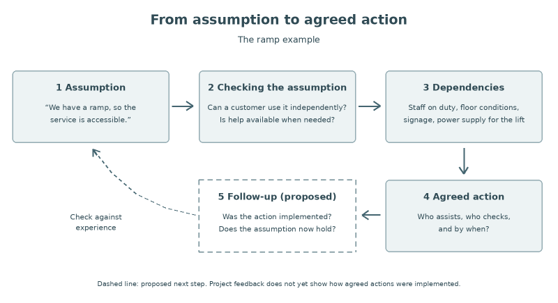
Figure 1. An illustrative example of how an accessibility assumption can lead to agreed action. Follow-up is shown as a proposed next step.
Separately from the Future Risk Labs, foresight methods were tested in Äkäslompolo in December 2025 and Sodankylä in March 2026. A trend review, a futures wheel and an impact–readiness matrix helped participants structure changes, their direct and indirect effects, and businesses’ readiness to respond. The time horizon ranged from the next season to longer-term decisions.
The session themes reflected regional priorities: Äkäslompolo focused on developing year-round tourism, while Sodankylä addressed tourism development across the municipality. Discussion quickly moved from trends towards possible actions, such as planning new products. Participants found the foresight approach useful and hoped that the work would continue. They also expressed interest in practicing preparedness for different scenarios. This points to a need for further development: foresight could be complemented with scenario-based exercises.
Local trust is a resource for risk management
Alongside the accessibility workshop in Sirkka, the examination of social sustainability in Salla highlighted the importance of staff induction, the treatment of seasonal workers and listening to residents. Trust between businesses and local communities emerged in all the Future Risk Labs. In Kemi and Rovaniemi, local relationships and earned trust were examined as resources supporting business communication and reputation. Alongside risks, it is important to recognize existing strengths such as tacit knowledge, local cooperation and trust.
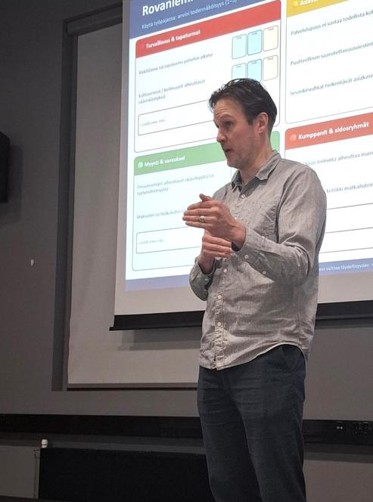
Figure 2. Reko Silvenius presents at the Future Risk Lab in Rovaniemi. Photo: Pasi Satokangas.
When the familiar explanation no longer fits
Feedback from a participant in Salla captured the potential of shared discussion: “The workshop discussions and introductory presentations brought up things I had not thought about before” (Matrix 2 project 2026; translated from Finnish).
Recognizing that our current understanding is inadequate can be useful. A greater problem is not knowing that we do not know. In that case, gaps in our knowledge remain unnoticed and we continue acting with unwarranted confidence. Dave Snowden (2020) distinguishes recognizing that our understanding is inadequate from being confused without realizing it. He describes the former through the concept of aporia. In Snowden’s use of the term, aporia involves recognizing that we do not know how to make sense of a situation and consciously staying with that uncertainty rather than rushing to a familiar explanation. Aporia can also be deliberately prompted through questions and contradictions that require people to think differently.
The question at the beginning of this article can prompt this kind of reconsideration. “The ramp is there, but can a customer use it?” does not provide an answer. It reveals an assumption that may have gone unchecked. The same question can be asked about any assumption underpinning a business’s operations.
Shared discussion must therefore allow people to express uncertainty and raise observations that challenge established understandings. Customers, staff and partners may hold different assumptions about responsibilities and necessary actions. The value of aporia lies in how it is addressed and what is changed as a result.
From insight to everyday business practice
The Matrix 2 digital toolkit structures preparedness through four components. “Valmius” (readiness) helps assess preparedness maturity, “Lista” (checklist) examines minimum requirements, and “Startti” (getting started) helps establish the current situation. “Plus” supports risk assessment and action planning. The aim is to make risk management part of a business’s routine planning.
Five tourism entrepreneurs tested the Riskienhallinta Plus (risk management) tool in spring 2026. Feedback indicated that the tool was useful for documenting ideas and planning the next season. Areas for improvement included the amount of text, the small font size and insufficient guidance. Based on the feedback, the tool’s interface was simplified and its guidance supplemented before publication.
A business can begin by examining one service: what does its success depend on, whose expertise does it rely on, and what happens if a necessary condition is missing? When an observation leads to an agreed action, that action also needs a responsible person and a date for checking its implementation.
Feedback from Matrix 2 indicates perceived benefits and new insights but does not yet show how the planned actions were implemented. Future follow-up should examine whether agreed responsibilities and practices become part of businesses’ everyday operations, whether cooperation continues and whether plans are reviewed in light of experience. Only then can we assess how the development work supports the operational capacity of businesses and their networks in changing situations.
References
Hollnagel, E., Leonhardt, J. & Shorrock, S. 2013. From Safety-I to Safety-II: A White Paper. EUROCONTROL.
Matrix 2 project 2026. Future Risk Lab toteutusten raportti tuloksista. Lapland University of Applied Sciences. Project report.
Snowden, D. 2020. Cynefin St David’s Day 2020 (2 of 5). The Cynefin Co. Blog post, 3 March 2020. https://thecynefin.co/cynefin-st-davids-day-2020-2-of-n/